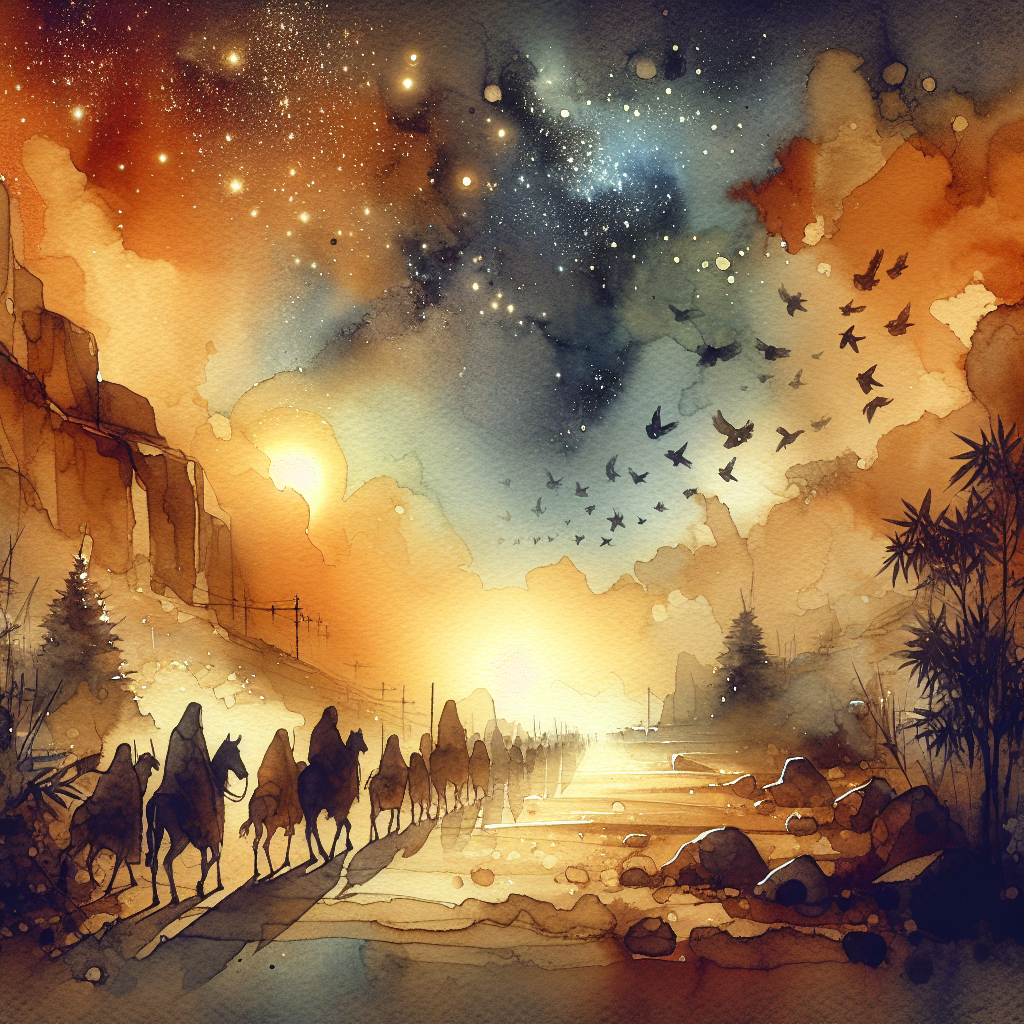
Count the Stars: Genesis 15:1-21
After this, the word of the LORD came to Abram in a vision: "Do not be afraid, Abram. I am your shield, your very great reward."
Fear had crept in. Abram had just defeated four kings to rescue Lot, but victory brought vulnerability. What if they returned? What if he had made powerful enemies?
God's answer was himself: I am your shield. I am your reward. Not just protection and provision—God himself as the gift.
But Abram said, "Sovereign LORD, what can you give me since I remain childless and the one who will inherit my estate is Eliezer of Damascus?"
The old grief surfaced. Promises of offspring, promises of land, promises of blessing—but Sarai's womb remained closed, and Abram was preparing to leave everything to a servant.
"This man will not be your heir, but a son who is your own flesh and blood will be your heir."
Your own flesh and blood. Not adoption. Not substitution. A real son from his own body.
He took him outside and said, "Look up at the sky and count the stars—if indeed you can count them."
Abram stepped out of his tent into the desert night. Above him, the Milky Way blazed across the darkness—thousands upon thousands of stars, more than the eye could separate, more than the mind could number.
Then he said to him, "So shall your offspring be."
So shall your offspring be. An army of descendants stretching across history like stars across the sky. From a childless man and a barren woman, a constellation of souls.
Abram believed the LORD, and he credited it to him as righteousness.
This verse would echo through the rest of Scripture. Not works but faith. Not performance but trust. Abram stood beneath uncountable stars, believed what God said, and God called him righteous.
But belief needed confirming. God would make a covenant.
He said to him, "Bring me a heifer, a goat and a ram, each three years old, along with a dove and a young pigeon."
Abram brought them, cut them in two, and arranged the halves opposite each other. The birds he did not cut in two.
A covenant ritual. In the ancient world, parties making a treaty would walk between the pieces, essentially saying: "May I be torn apart like these animals if I break this covenant."
Then birds of prey came down on the carcasses, but Abram drove them away.
All day he guarded the sacrifice, fighting off vultures that swooped to steal the offering. The sun crawled across the sky. The blood dried on the ground.
As the sun was setting, Abram fell into a deep sleep, and a thick and dreadful darkness came over him.
The same deep sleep that had fallen on Adam before Eve's creation. But this time, darkness accompanied it—terrifying, heavy, prophetic.
Then the LORD said to him: "Know for certain that for four hundred years your descendants will be strangers in a country not their own and that they will be enslaved and mistreated there. But I will punish the nation they serve as slaves, and afterward they will come out with great possessions."
Egypt. Slavery. Exodus. Four hundred years compressed into a few sentences. The good news came wrapped in terrible news. The promise included suffering.
"You, however, will go to your ancestors in peace and be buried at a good old age. In the fourth generation your descendants will come back here, for the sin of the Amorites has not yet reached its full measure."
The timing was tied to justice. God would not give Canaan to Abraham's descendants until the Canaanites had filled up their sin. Even judgment waited for righteousness.
When the sun had set and darkness had fallen, a smoking firepot with a blazing torch appeared and passed between the pieces.
This was the moment. But notice: only God passed between the pieces. Abram did not walk the blood-path. The covenant was unilateral—God binding himself, God taking the oath, God shouldering the consequences of failure.
If this covenant was broken, God himself would be torn apart.
On that day the LORD made a covenant with Abram and said, "To your descendants I give this land, from the Wadi of Egypt to the great river, the Euphrates."
The boundaries were named. The promise was signed in fire and blood. A childless wanderer had become heir to a continent.
Abram slept beneath the stars that night—stars he could not count, each one a promise, each one a child yet to be born.
Powered by ChurchWiseAI
This illustration is a preview of what our AI-powered ministry platform can do. ChurchWiseAI offers a full suite of tools built for pastors and church leaders.
Sermon Companion
Build entire sermons with AI — outlines, illustrations, application points, and slide decks tailored to your tradition.
Ministry Chatbot
An AI assistant trained on theology, counseling frameworks, and church administration to help with any ministry question.
Bible Study Builder
Generate discussion guides, devotionals, and small group materials from any passage — in minutes, not hours.
Try any app free for 7 days — no credit card required.
Get Started