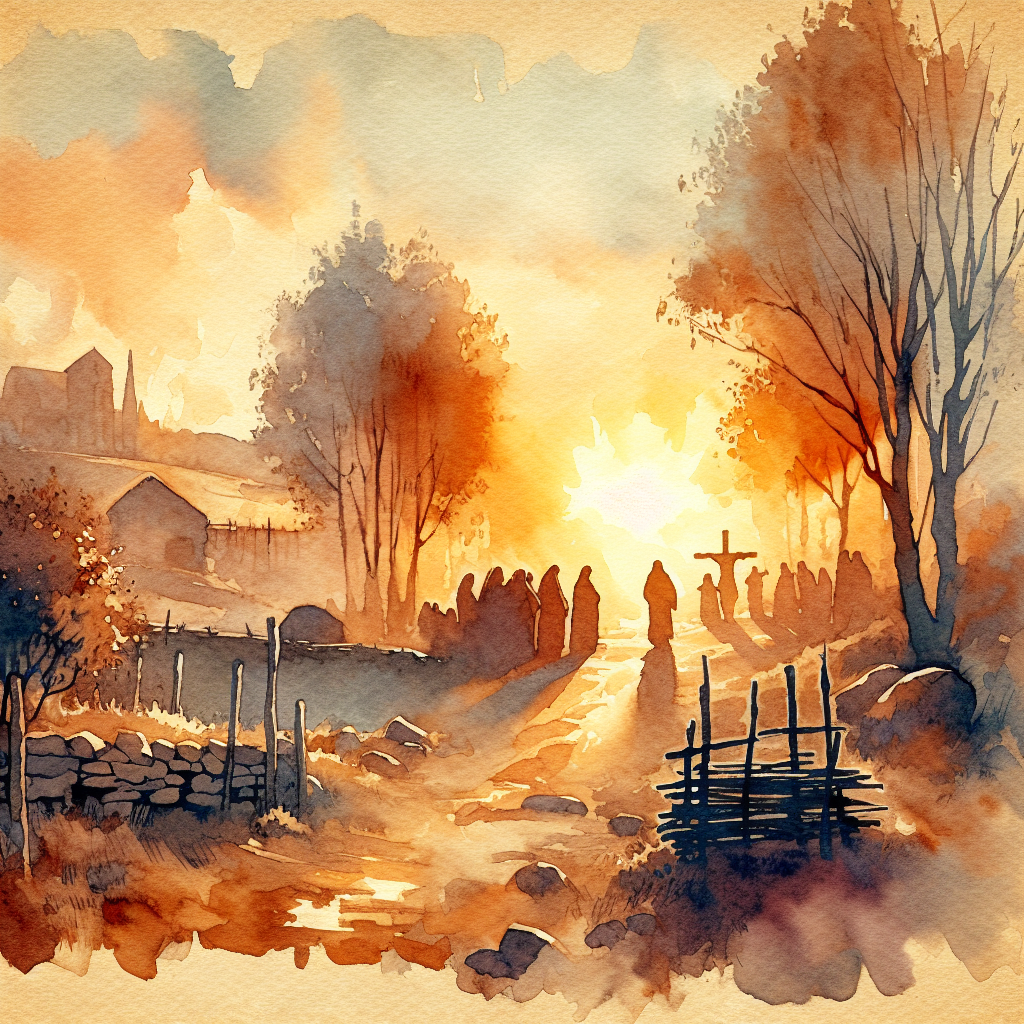
Dead and Alive: Romans 6:1-14
What shall we say, then? Shall we go on sinning so that grace may increase? By no means!
She heard the argument before. If grace covers sin, why not sin more? Get more grace. The logic seemed airtight to some.
But it missed everything.
We are those who have died to sin; how can we live in it any longer?
Died to sin. She turned the phrase over in her mind. What did it mean—died?
She thought about death. Real death. Her father's death three years ago. He didn't struggle with bills anymore. Didn't argue with her mother. Didn't worry about his health. Death ended his relationship to all of it.
Died to sin. Could it be that simple? That her relationship to sin had ended? That she was no longer obligated to it, bound to it, responsive to it?
Or don't you know that all of us who were baptized into Christ Jesus were baptized into his death?
She remembered her baptism. The water closing over her head. The moment of submersion—completely covered, completely under.
Baptized into his death. Not just getting wet. Union with Christ in his death. What happened to him happened to her. When he died, she died.
We were therefore buried with him through baptism into death in order that, just as Christ was raised from the dead through the glory of the Father, we too may live a new life.
Buried with him. The going down. The grave. The finality.
Raised with him. The coming up. The glory. The newness.
She had come up from that water. Gasping, dripping, alive. New life—that's what she had been given. Not improved life. Not reformed life. New life.
For if we have been united with him in a death like his, we will certainly also be united with him in a resurrection like his.
United. The word was intimate—grown together, fused, joined. United with him in death. United with him in resurrection. What was true of Christ was true of those in Christ.
She would be raised. Certainly. The certainty wasn't in her faith but in her union. Because she was in him, she would share his future.
For we know that our old self was crucified with him so that the body ruled by sin might be done away with, that we should no longer be slaves to sin.
Our old self. She had one. Everyone did. The person she was before Christ—self-centered, sin-enslaved, spiritually dead. That old self was crucified.
Crucified with him. She pictured it—her old self nailed to the cross with Jesus. Not just forgiven but executed. Put to death. Ended.
The body ruled by sin—done away with. Not annihilated but rendered powerless. Sin's tyranny broken. The slave chains cut.
No longer slaves to sin. She had been a slave. She knew it now, looking back. Compelled by desires she didn't choose. Driven by impulses she couldn't control. A slave.
But no longer. The old master was still there, still calling, still demanding. But the legal relationship was severed. She didn't have to obey anymore.
Because anyone who has died has been set free from sin.
Death breaks all contracts. Death ends all obligations. Death severs all relationships. She had died with Christ. Sin's claim on her was void.
Now if we died with Christ, we believe that we will also live with him.
The future rooted in the past. Because she died with Christ—past event, settled fact—she would live with him. Present life flowing into eternal life.
For we know that since Christ was raised from the dead, he cannot die again; death no longer has mastery over him.
Christ was raised. Once. Finally. Permanently. Death tried to hold him and failed. Death has no more claim on the risen Christ.
The death he died, he died to sin once for all; but the life he lives, he lives to God.
Once for all. Not repeated. Not ongoing. Finished. Complete. Christ's death to sin was decisive and final.
The life he lives—present tense, continuous—he lives to God. Oriented toward God. Devoted to God. For God.
In the same way, count yourselves dead to sin but alive to God in Christ Jesus.
Count yourselves. Reckon. Consider. Believe it to be true because it is true.
She sat in her car, engine running, parked outside the bar where she used to spend every Friday night. The pull was still there. The old patterns still beckoned. The friends inside still texted.
Dead to sin. She said it out loud. Dead to sin. The old self crucified. The slave contract voided. She didn't have to go in.
Alive to God. She said that too. Alive to God in Christ Jesus. New life. New master. New orientation.
Therefore do not let sin reign in your mortal body so that you obey its evil desires.
Do not let. The command assumed she had power not to let. Sin would try to reign. It would make a play for the throne. But she didn't have to let it.
Her mortal body. Still mortal. Still weak. Still susceptible to evil desires. But no longer under sin's dominion.
Do not offer any part of yourself to sin as an instrument of wickedness, but rather offer yourselves to God as those who have been brought from death to life.
Offer. The word was sacrificial. Her hands—she could offer them to sin or to God. Her eyes. Her tongue. Her feet. Every part of her was an instrument to be offered.
Brought from death to life. That's who she was now. A resurrection person. One who had been dead and was now alive.
And offer every part of yourself to him as an instrument of righteousness.
She put the car in reverse. Backed out of the parking space. Drove away from the bar, from the old life, from the grave she had climbed out of.
For sin shall no longer be your master, because you are not under the law, but under grace.
Not under law—the system that commanded but couldn't empower. Under grace—the system that forgave and transformed.
Sin was no longer her master. She had a new master now. A better master. The one who loved her enough to die for her and powerful enough to raise her with him.
Dead to sin. Alive to God.
She drove toward home, toward the new life, toward the freedom she was still learning to live in.
Creative Approach
experiential_vignette
Powered by ChurchWiseAI
This illustration is a preview of what our AI-powered ministry platform can do. ChurchWiseAI offers a full suite of tools built for pastors and church leaders.
Sermon Companion
Build entire sermons with AI — outlines, illustrations, application points, and slide decks tailored to your tradition.
Ministry Chatbot
An AI assistant trained on theology, counseling frameworks, and church administration to help with any ministry question.
Bible Study Builder
Generate discussion guides, devotionals, and small group materials from any passage — in minutes, not hours.
Try any app free for 7 days — no credit card required.
Get Started