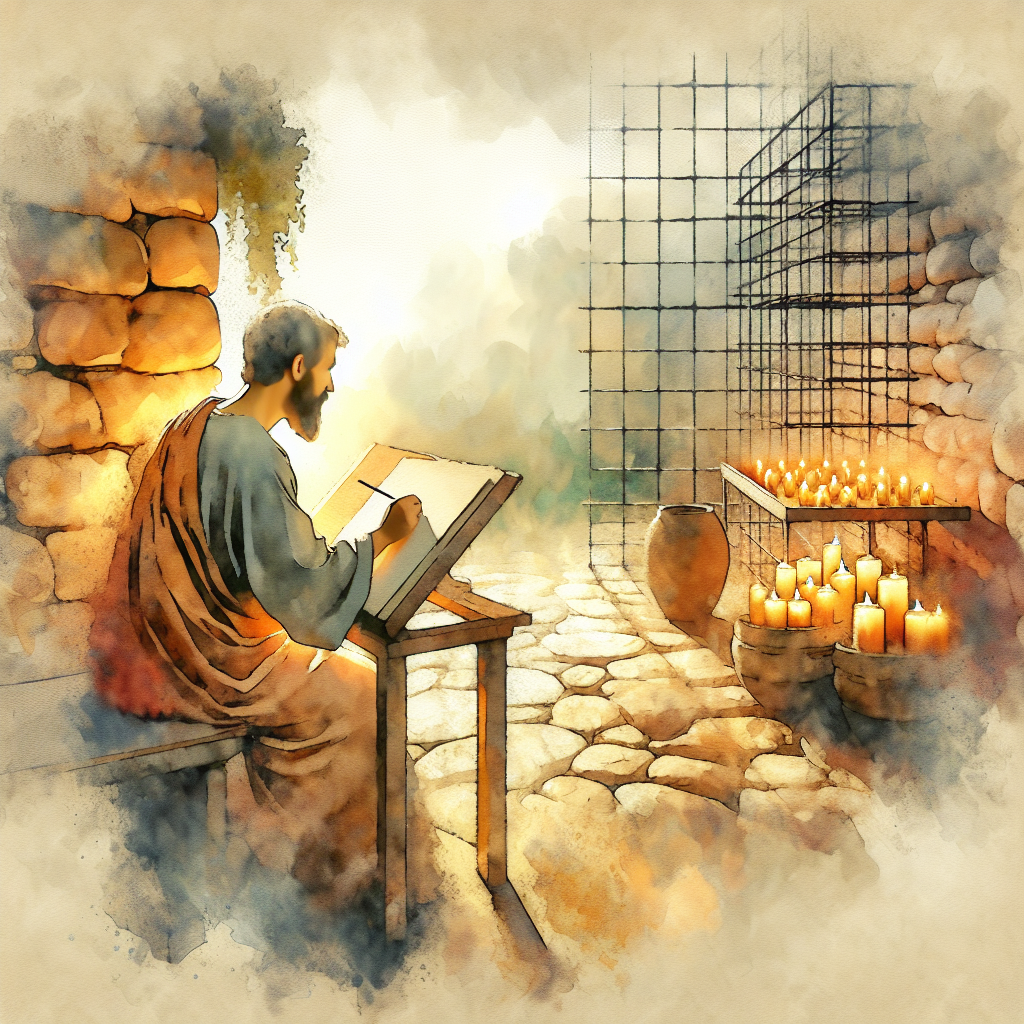
From the Mamertine: Paul's Letter to His Beloved Son
The cell is cold.
Not the rented quarters of his first Roman imprisonment, where he could receive visitors and write letters in relative comfort. This is the Mamertine—or something like it. Underground. Damp. Dark except for what little light filters through the opening above.
Paul is going to die here.
He knows it. The trial has gone badly—or will go badly. The emperor's madness deepens by the month. Christians are blamed for the fire that consumed Rome. And Paul, the movement's most visible apostle, will not escape.
But there is one more letter to write.
"Paul, an apostle of Christ Jesus by the will of God, in keeping with the promise of life that is in Christ Jesus, to Timothy, my dear son."
ἀγαπητῷ τέκνῳ—beloved child. The warmth persists even from prison. Especially from prison. When everything is stripped away, what remains is love.
"Grace, mercy and peace from God the Father and Christ Jesus our Lord."
The standard greeting. But nothing is standard now. Grace needed. Mercy needed. Peace—εἰρήνη—needed most of all.
"I thank God, whom I serve, as my ancestors did, with a clear conscience, as night and day I constantly remember you in my prayers."
Night and day. ἀδιαλείπτως. Without ceasing. In the darkness of the cell, when sleep won't come, Paul prays for Timothy. The faces of loved ones persist when all else fades.
"Recalling your tears, I long to see you, so that I may be filled with joy."
Timothy wept at their parting. Paul remembers those tears—δακρύων σου μεμνημένος. And now, facing death, he longs to see that face again. ἐπιποθῶν σε ἰδεῖν—yearning, aching for one more meeting.
Will it happen? Paul doesn't know. But the longing is real.
"I am reminded of your sincere faith, which first lived in your grandmother Lois and in your mother Eunice and, I am persuaded, now lives in you also."
Three generations of faith. Lois to Eunice to Timothy. ἀνυποκρίτου πίστεως—unhypocritical faith, faith without pretense, faith that is what it appears to be. The women who raised Timothy planted something genuine.
And now Paul's charge:
"For this reason I remind you to fan into flame the gift of God, which is in you through the laying on of my hands."
ἀναζωπυρεῖν τὸ χάρισμα τοῦ θεοῦ. To rekindle, to fan back to life, to stir up the coals. The gift is already present—implanted at ordination, when Paul's hands rested on Timothy's head. But gifts can smolder. Flames can die low. Timothy must blow on the embers.
"For the Spirit God gave us does not make us timid, but gives us power, love and self-discipline."
οὐ γὰρ ἔδωκεν ἡμῖν ὁ θεὸς πνεῦμα δειλίας. Not a spirit of cowardice. Not fear that paralyzes. The Spirit gives δύναμιν—power. ἀγάπην—love. σωφρονισμοῦ—sound-mindedness, self-control, disciplined thinking.
Why does Paul mention cowardice? Perhaps Timothy is afraid. Perhaps the same forces that have imprisoned Paul threaten Timothy. Perhaps the young pastor is tempted to shrink back.
Paul won't let him.
"So do not be ashamed of the testimony about our Lord or of me his prisoner."
μὴ οὖν ἐπαισχυνθῇς. Don't be ashamed. The testimony about Christ—that scandalous message of a crucified Messiah—invites shame in a world that prizes power. And Paul himself, chained like a criminal, could be an embarrassment.
Don't be ashamed. Not of the message. Not of the messenger.
"Rather, join with me in suffering for the gospel, by the power of God."
συγκακοπάθησον τῷ εὐαγγελίῳ. Suffer-together-with. The invitation isn't to comfort but to companionship in pain. Paul can't offer Timothy success; he offers shared suffering. κατὰ δύναμιν θεοῦ—according to God's power. The strength to suffer comes from outside ourselves.
"He has saved us and called us to a holy life—not because of anything we have done but because of his own purpose and grace."
Salvation recap. σώσαντος—the one who saved. καλέσαντος—the one who called. κλήσει ἁγίᾳ—holy calling. And the basis? Not works. οὐ κατὰ τὰ ἔργα ἡμῶν. Purpose and grace. ἀλλὰ κατὰ ἰδίαν πρόθεσιν καὶ χάριν.
"This grace was given us in Christ Jesus before the beginning of time, but it has now been revealed through the appearing of our Savior, Christ Jesus, who has destroyed death and has brought life and immortality to light through the gospel."
πρὸ χρόνων αἰωνίων—before eternal times. Grace planned before creation. Now revealed—φανερωθεῖσαν—through Christ's appearing. And what has Christ accomplished? καταργήσαντος μὲν τὸν θάνατον—abolished death. φωτίσαντος δὲ ζωὴν καὶ ἀφθαρσίαν—illuminated life and immortality.
Death is destroyed. Paul writes this from a death cell. The irony is intentional. Whatever Rome does to his body, death itself has been defeated.
"And of this gospel I was appointed a herald and an apostle and a teacher. That is why I am suffering as I am."
The reason for the chains. The gospel made him herald, apostle, teacher. The gospel brought him here.
"Yet this is no cause for shame, because I know whom I have believed, and am convinced that he is able to guard what I have entrusted to him until that day."
οἶδα γὰρ ᾧ πεπίστευκα. I know whom I have believed. Not what—whom. Personal trust in a personal Savior. And πέπεισμαι—I am convinced, I have been persuaded and remain persuaded. He is able to guard τὴν παραθήκην μου—my deposit. The thing Paul has entrusted to God.
Until that day. ἐκείνην τὴν ἡμέραν. The day of Christ's appearing. The day of resurrection. The day that makes sense of every prison and every martyrdom.
---
"What you heard from me, keep as the pattern of sound teaching, with faith and love in Christ Jesus. Guard the good deposit that was entrusted to you—guard it with the help of the Holy Spirit who lives in us."
ὑποτύπωσιν ἔχε—hold the pattern. ὑγιαινόντων λόγων—of healthy words. The same teaching Paul has delivered, Timothy must preserve.
φύλαξον τὴν καλὴν παραθήκην—guard the beautiful deposit. The same verb Paul used of God's guarding. Now it's Timothy's task. διὰ πνεύματος ἁγίου—through the Holy Spirit. Not alone.
"You know that everyone in the province of Asia has deserted me, including Phygelus and Hermogenes."
The pain surfaces. πάντες με ἀπεστράφησαν. All in Asia turned away. The church Paul planted, the province where Ephesus sits—abandonment. Phygelus. Hermogenes. Names preserved in Scripture as deserters.
"May the Lord show mercy to the household of Onesiphorus, because he often refreshed me and was not ashamed of my chains. On the contrary, when he was in Rome, he searched hard for me until he found me."
But not everyone fled. Onesiphorus—"profit-bringer"—living up to his name. πολλάκις με ἀνέψυξεν—often refreshed me. Sought Paul out despite the danger. Wasn't ashamed of the chains.
"May the Lord grant that he will find mercy from the Lord on that day!"
ἐκείνῃ τῇ ἡμέρᾳ—that day again. The day that matters. The day that repays every kindness and exposes every desertion.
"You know very well how many ways he helped me in Ephesus."
Timothy knows. He was there. He saw Onesiphorus's faithfulness.
The contrast is deliberate. Phygelus and Hermogenes—fled. Onesiphorus—stayed, searched, refreshed. Timothy must choose which pattern to follow.
---
Paul sets down the stylus.
The letter has barely begun, but the core is already there.
Fan into flame. Don't be ashamed. Guard the deposit. Suffer together.
The cell grows darker as evening approaches.
Paul prays Timothy will come before winter.
But if not—the words are written. The torch is passed.
The flame must not go out.
Creative Approach
apostolic_dictation
Powered by ChurchWiseAI
This illustration is a preview of what our AI-powered ministry platform can do. ChurchWiseAI offers a full suite of tools built for pastors and church leaders.
Sermon Companion
Build entire sermons with AI — outlines, illustrations, application points, and slide decks tailored to your tradition.
Ministry Chatbot
An AI assistant trained on theology, counseling frameworks, and church administration to help with any ministry question.
Bible Study Builder
Generate discussion guides, devotionals, and small group materials from any passage — in minutes, not hours.
Try any app free for 7 days — no credit card required.
Get Started