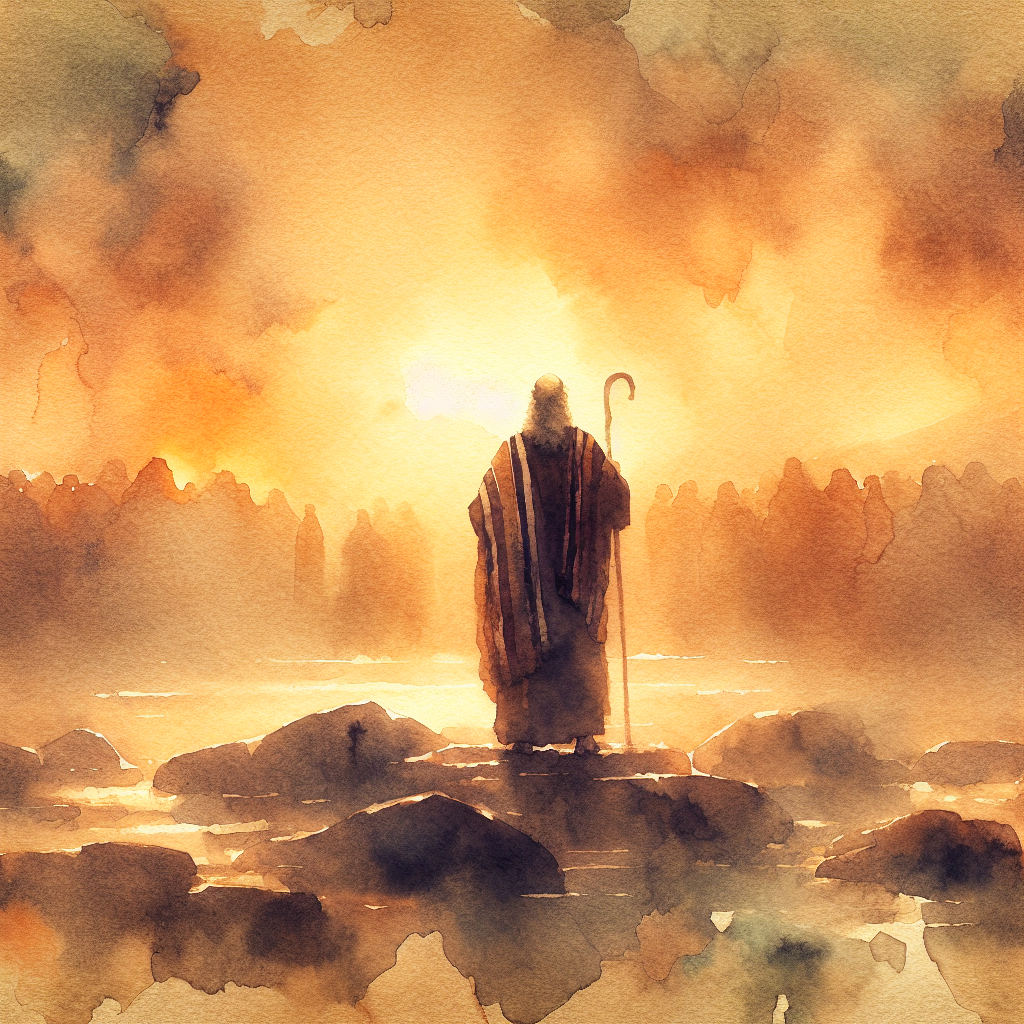
I AM WHO I AM: Exodus 3:1-15
Now Moses was tending the flock of Jethro his father-in-law, the priest of Midian, and he led the flock to the far side of the wilderness and came to Horeb, the mountain of God.
Forty years had passed. The prince of Egypt was now a shepherd in Midian. The far side of the wilderness—remote, desolate, forgotten. Moses had fled Egypt after killing an Egyptian, and now he tended sheep in obscurity.
Horeb—the mountain of God. Moses didn't know it yet, but he was standing on holy ground.
There the angel of the Lord appeared to him in flames of fire from within a bush. Moses saw that though the bush was on fire it did not burn up.
Fire without consumption. Flames without destruction. The bush burned but was not burned. Bushes catch fire in deserts—but they burn up quickly. This one kept burning.
So Moses thought, I will go over and see this strange sight—why the bush does not burn up.
Curiosity drew him closer. Strange sight—the Hebrew suggests a great wonder. Moses turned aside from his ordinary path to investigate the extraordinary.
When the Lord saw that he had turned aside to look, God called to him from within the bush, Moses! Moses!
God waited for Moses to turn. The burning bush was an invitation, not an interruption. And when Moses came, God spoke. Moses! Moses! His name, twice, with urgency.
And Moses said, Here I am.
Here I am. Hineni. The response of availability, of readiness, of submission. Abraham said it. Jacob said it. Samuel would say it. Here I am.
Do not come any closer, God said. Take off your sandals, for the place where you are standing is holy ground.
Stop. No closer. The ground had changed—or rather, Moses' perception had changed. The wilderness dirt was holy because God was present. Sandals off. Bare feet on sacred soil.
Then he said, I am the God of your father, the God of Abraham, the God of Isaac and the God of Jacob.
Identity revealed. Not a new god but the ancestral God. Abraham's God. Isaac's God. Jacob's God. The God who made promises was now speaking to Moses.
At this, Moses hid his face, because he was afraid to look at God.
Fear appropriate to the encounter. Moses hid his face. The curiosity that drew him near now gave way to terror. To see God was dangerous.
The Lord said, I have indeed seen the misery of my people in Egypt. I have heard them crying out because of their slave drivers, and I am concerned about their suffering.
God sees. God hears. God is concerned. Three verbs of divine attention. The slavery had not gone unnoticed. The cries had reached heaven. God was not indifferent.
So I have come down to rescue them from the hand of the Egyptians and to bring them up out of that land into a good and spacious land, a land flowing with milk and honey.
Come down. God descending to rescue. The mission: extract them from Egypt, relocate them to promise. Milk and honey—abundance, fertility, blessing.
And now the cry of the Israelites has reached me, and I have seen the way the Egyptians are oppressing them.
Repeated for emphasis. The cry reached me. I have seen the oppression. The divine attention is complete.
So now, go. I am sending you to Pharaoh to bring my people the Israelites out of Egypt.
The commission. Go. I am sending you. The shepherd of sheep would become shepherd of a nation. The fugitive would face the throne.
But Moses said to God, Who am I that I should go to Pharaoh and bring the Israelites out of Egypt?
The first objection. Who am I? The prince-turned-shepherd, the murderer in exile, the forgotten man in the wilderness. Who am I to face Pharaoh?
And God said, I will be with you. And this will be the sign to you that it is I who have sent you: When you have brought the people out of Egypt, you will worship God on this mountain.
The answer bypassed Moses' qualifications. I will be with you. Not who you are but who I am with you. The sign would come after obedience—worship on this very mountain.
Moses said to God, Suppose I go to the Israelites and say to them, The God of your fathers has sent me to you, and they ask me, What is his name? Then what shall I tell them?
The second objection. What's your name? The Israelites had been in Egypt four hundred years. They knew Egyptian gods with Egyptian names. What name does this God have?
God said to Moses, I AM WHO I AM. This is what you are to say to the Israelites: I AM has sent me to you.
The name above all names. I AM WHO I AM. Ehyeh asher ehyeh. Self-existent. Self-sufficient. Uncaused. Undefined by anything outside himself.
I AM. Not I was. Not I will be. I AM—eternal present tense. The ground of all being. The source of all existence.
God also said to Moses, Say to the Israelites, The LORD, the God of your fathers—the God of Abraham, the God of Isaac and the God of Jacob—has sent me to you. This is my name forever, the name you shall call me from generation to generation.
The LORD—Yahweh—the personal name connected to I AM. Forever. From generation to generation. The name that Israel would treasure, protect, and eventually consider too holy to pronounce.
From burning bush to burning mission. From holy ground to holy calling. From I AM to "Go." The shepherd would face Pharaoh with nothing but a name—and that name was enough.
Powered by ChurchWiseAI
This illustration is a preview of what our AI-powered ministry platform can do. ChurchWiseAI offers a full suite of tools built for pastors and church leaders.
Sermon Companion
Build entire sermons with AI — outlines, illustrations, application points, and slide decks tailored to your tradition.
Ministry Chatbot
An AI assistant trained on theology, counseling frameworks, and church administration to help with any ministry question.
Bible Study Builder
Generate discussion guides, devotionals, and small group materials from any passage — in minutes, not hours.
Try any app free for 7 days — no credit card required.
Get Started