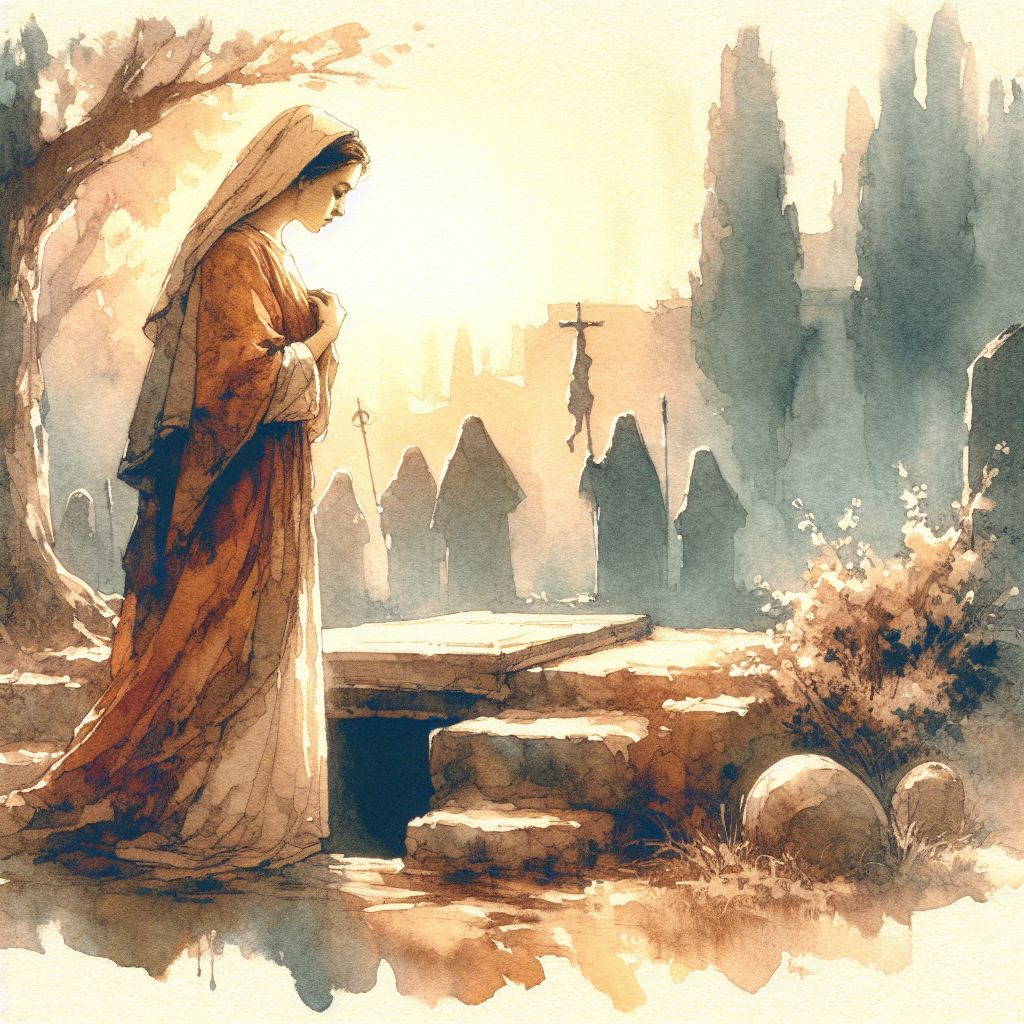
Mary in the Garden: John 20:1-18
Early on the first day of the week, while it was still dark, Mary Magdalene went to the tomb and saw that the stone had been removed from the entrance.
Still dark. Mary couldn't wait for full daylight. Grief drove her to the tomb before dawn. The stone—massive, sealed, guarded—was moved.
So she came running to Simon Peter and the other disciple, the one Jesus loved, and said, They have taken the Lord out of the tomb, and we don't know where they have put him!
Running. Breathless report. They have taken him. Mary's first assumption: grave robbery, body theft. Not resurrection—that didn't cross her mind yet.
So Peter and the other disciple started for the tomb. Both were running, but the other disciple outran Peter and reached the tomb first.
A footrace to the grave. John was faster—younger perhaps. He arrived first.
He bent over and looked in at the strips of linen lying there but did not go in.
John saw the grave clothes but stopped at the entrance. Something held him back—reverence, fear, uncertainty.
Then Simon Peter came along behind him and went straight into the tomb.
Peter, characteristically, burst right in. No hesitation. He saw the linen strips lying there.
He saw the strips of linen lying there, as well as the cloth that had been wrapped around Jesus' head. The cloth was still lying in its place, separate from the linen.
Details that meant everything. The grave clothes were not unwound and discarded. They lay in place—as if the body had simply passed through them. The head cloth folded separately, deliberately. No grave robber would take time for this.
Finally the other disciple, who had reached the tomb first, also went inside. He saw and believed.
John entered, saw, believed. The evidence convinced him. The arrangement of grave clothes spoke of resurrection, not robbery.
(They still did not understand from Scripture that Jesus had to rise from the dead.)
Understanding would come. For now, faith preceded comprehension.
Then the disciples went back to where they were staying.
Peter and John left. But Mary stayed.
Now Mary stood outside the tomb crying. As she wept, she bent over to look into the tomb and saw two angels in white, seated where Jesus' body had been, one at the head and the other at the foot.
Through tears, Mary saw angels. White-robed figures at head and foot—where the body had lain. The mercy seat imagery: two cherubim flanking the place of atonement.
They asked her, Woman, why are you crying?
The question invited explanation, not information. Angels knew why she wept.
They have taken my Lord away, she said, and I don't know where they have put him.
Still thinking theft. My Lord—the personal possession of love.
At this, she turned around and saw Jesus standing there, but she did not realize that it was Jesus.
Jesus stood behind her. She turned and saw—but didn't recognize. Tears blurred vision. Resurrection was impossible. She saw what she expected: a gardener.
He asked her, Woman, why are you crying? Who is it you are looking for?
The same question the angels asked. Then a new one: who are you looking for? Jesus invited her to name her search.
Thinking he was the gardener, she said, Sir, if you have carried him away, tell me where you have put him, and I will get him.
Desperation in the offer. She would carry the body herself—impossible weight, impossible task. Love made impossible offers.
Jesus said to her, Mary.
One word. Her name. In his voice. The voice she knew.
She turned toward him and cried out in Aramaic, Rabboni! (which means Teacher).
Rabboni—more intimate than Rabbi. My Teacher. Recognition exploded. It was Jesus.
Jesus said, Do not hold on to me, for I have not yet ascended to the Father. Go instead to my brothers and tell them, I am ascending to my Father and your Father, to my God and your God.
She must have reached for him, clung to him. But the old relationship was changing. Ascension was coming. A message needed carrying.
My brothers—the disciples, newly named as family. My Father and your Father. My God and your God. Shared relationship, shared inheritance.
Mary Magdalene went to the disciples with the news: I have seen the Lord! And she told them that he had said these things to her.
The first witness. The first evangelist. A woman, in a culture that discounted women's testimony. Mary carried resurrection news: I have seen the Lord.
From the darkness before dawn to the light of the risen Christ. From tears at an empty tomb to joy in speaking her name. From I don't know where they have put him to I have seen the Lord.
Mary was the first to meet the risen Jesus. She was looking for a body and found a person. She expected death and discovered life.
Powered by ChurchWiseAI
This illustration is a preview of what our AI-powered ministry platform can do. ChurchWiseAI offers a full suite of tools built for pastors and church leaders.
Sermon Companion
Build entire sermons with AI — outlines, illustrations, application points, and slide decks tailored to your tradition.
Ministry Chatbot
An AI assistant trained on theology, counseling frameworks, and church administration to help with any ministry question.
Bible Study Builder
Generate discussion guides, devotionals, and small group materials from any passage — in minutes, not hours.
Try any app free for 7 days — no credit card required.
Get Started