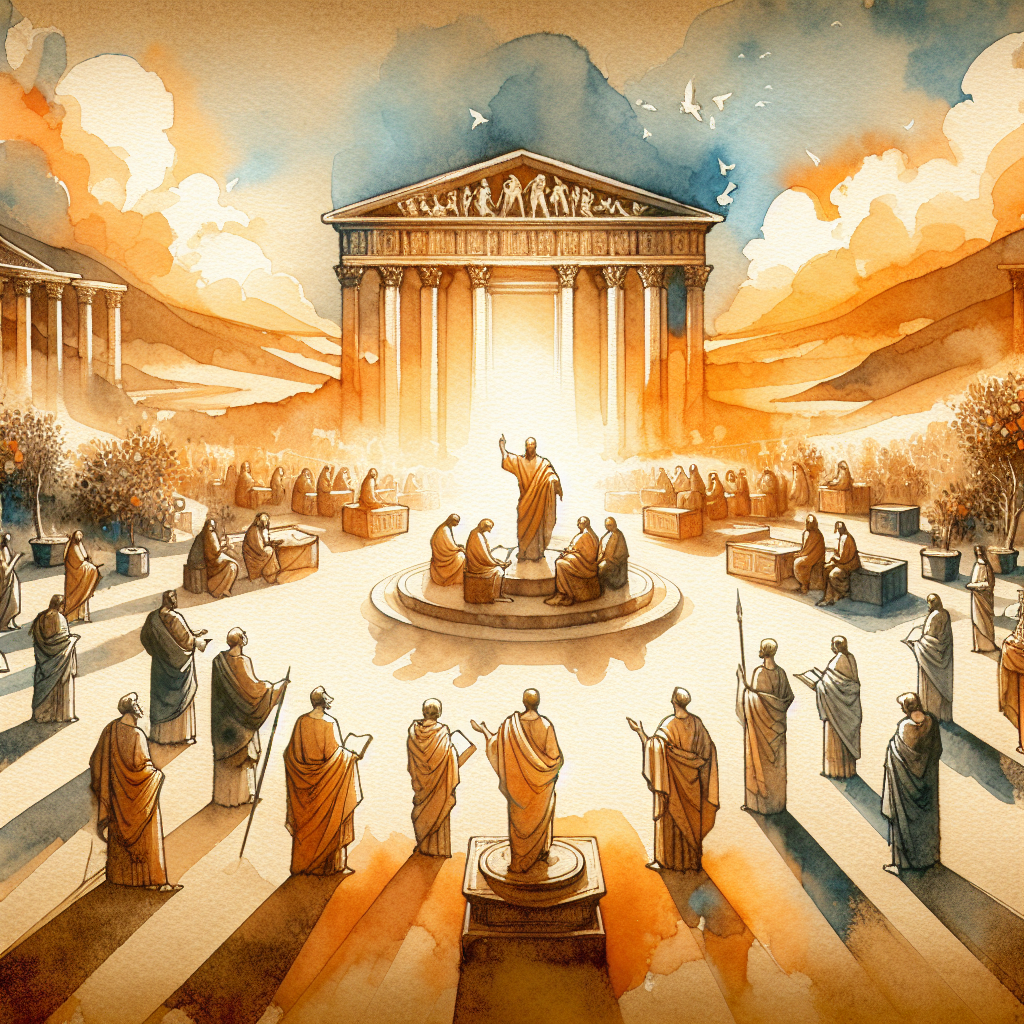
Paul's Anguish: Romans 9:1-5
Tertius paused, stylus hovering. Paul had stopped pacing.
The room in Gaius's house had grown quiet. For eight chapters, Paul had been building—wrath, justification, peace, no condemnation, nothing can separate. The theology was soaring, triumphant, complete.
Now something changed in Paul's voice.
"I speak the truth in Christ—I am not lying, my conscience confirms it through the Holy Spirit."
The triple attestation startled Tertius. Truth in Christ. Not lying. Conscience confirming. Paul was about to say something that would sound unbelievable.
"I have great sorrow and unceasing anguish in my heart."
Sorrow. Anguish. The words dropped heavy in the lamplight. After the heights of Romans 8—nothing can separate us—Paul plunged into grief.
For Israel.
"For I could wish that I myself were cursed and cut off from Christ for the sake of my people, those of my own race, the people of Israel."
Tertius stopped writing. He looked up at Paul, certain he had misheard.
Cursed. Cut off from Christ. Anathema—the word reserved for those under divine judgment, separated forever from salvation.
Paul, who had just declared that nothing could separate him from the love of God, now said he could wish to be separated—for his people.
The room fell silent except for the oil lamp's quiet hiss. Paul's face was wet.
His people. Those of his own race. Israel. The nation that rejected their Messiah. The people who had chased Paul from city to city, beaten him, conspired to kill him, opposed the gospel at every turn.
And he loved them so much he would trade his salvation for theirs.
"Theirs is the adoption to sonship."
Paul began to list what belonged to Israel. His voice steadied as he catalogued their privileges.
Adoption to sonship. God had called Israel his firstborn son. Out of Egypt I called my son. The adoption was real, formal, covenantal.
"Theirs the divine glory."
The Shekinah. The cloud by day, fire by night. The glory that filled the tabernacle until Moses couldn't enter. The glory that settled on the mercy seat. Israel had seen God's glory as no other nation had.
"Theirs the covenants."
Abraham, Isaac, Jacob. Moses at Sinai. David and the promise of an eternal throne. The new covenant prophesied through Jeremiah. Covenant after covenant—all given to Israel.
"Theirs the receiving of the law."
Sinai's thunder. The tablets written by God's finger. The Torah—the gift that distinguished Israel from all nations. Theirs.
"Theirs the temple worship."
The sacrifices, the priesthood, the holy days. The temple in Jerusalem where heaven and earth met. The worship given by God himself. Theirs.
"Theirs the promises."
Promise upon promise. Land. Descendants. Blessing to all nations. A coming king. A suffering servant. A new heart. Resurrection. The promises accumulated through centuries. Theirs.
"Theirs the patriarchs."
Abraham, Isaac, Jacob. Joseph, Moses, David. The fathers of the faith. The founders of the nation. The heroes of Israel's story. Theirs.
"And from them is traced the human ancestry of the Messiah."
Tertius's stylus pressed hard into the parchment. Here was the climax. The Messiah—the Christ—came from them. According to the flesh, Jesus of Nazareth was Jewish. Mary was Jewish. The genealogies in Matthew and Luke traced Jewish lineage.
The Christ was theirs.
"Who is God over all, forever praised! Amen."
Paul stopped. The doxology escaped unbidden. The Messiah who came from Israel—this one is God over all. Forever praised.
But Israel, by and large, had rejected him.
Paul stood at the window. The stars were out—the same stars Abraham had counted when God promised descendants too numerous to number.
Israel had received everything. Adoption, glory, covenants, law, worship, promises, patriarchs, Messiah. Everything.
And most had said no.
This was Paul's anguish. This was his unceasing sorrow. His own people—who had everything, who were given everything—were missing the one thing everything pointed to.
He would have traded places with them if he could.
Tertius waited. Finally Paul turned back to the lamplight.
"Continue writing," he said. "There is more to say."
Creative Approach
apostolic_dictation
Powered by ChurchWiseAI
This illustration is a preview of what our AI-powered ministry platform can do. ChurchWiseAI offers a full suite of tools built for pastors and church leaders.
Sermon Companion
Build entire sermons with AI — outlines, illustrations, application points, and slide decks tailored to your tradition.
Ministry Chatbot
An AI assistant trained on theology, counseling frameworks, and church administration to help with any ministry question.
Bible Study Builder
Generate discussion guides, devotionals, and small group materials from any passage — in minutes, not hours.
Try any app free for 7 days — no credit card required.
Get Started