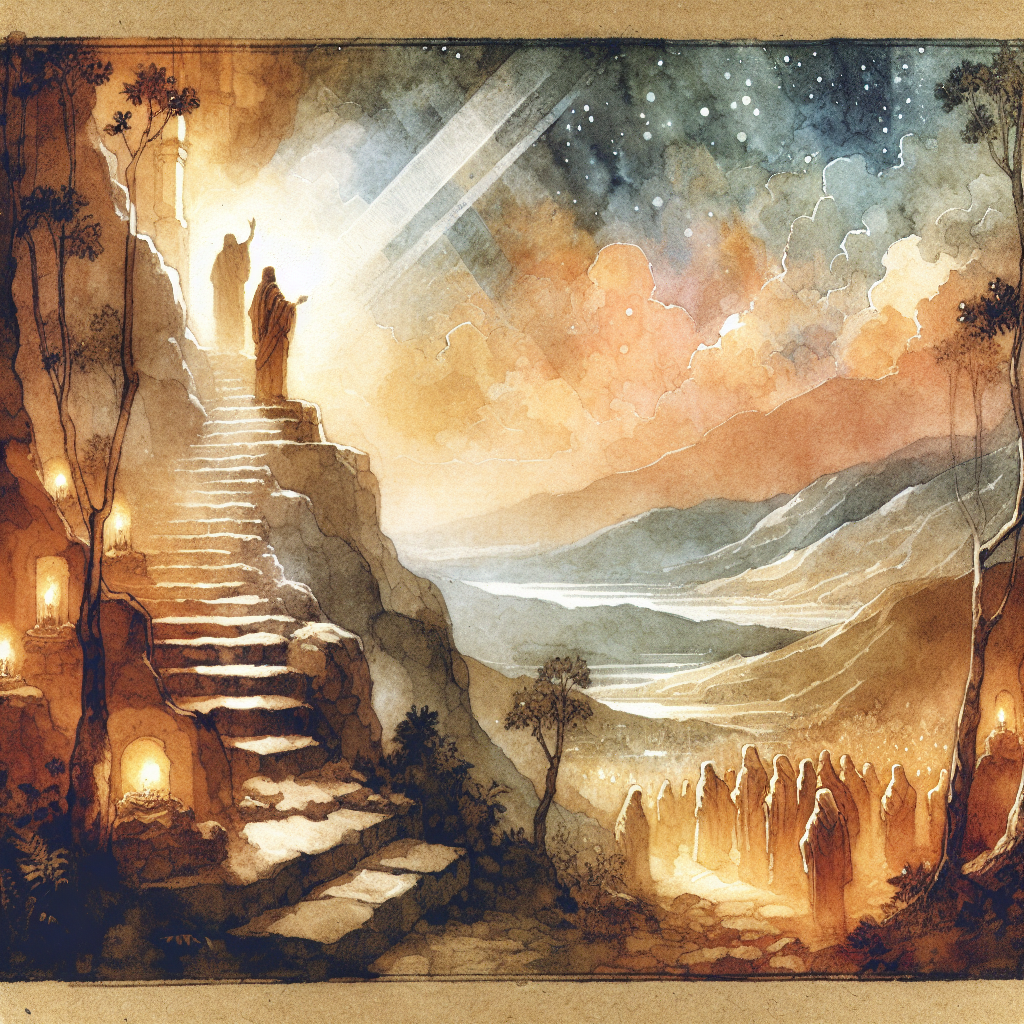
Stairway to Heaven: Genesis 28:10-22
Jacob left Beersheba and set out for Harran.
Running. Fleeing. Esau had vowed to kill him as soon as their father died, and Rebekah had sent Jacob away—back to her brother Laban, back to the old country, away from his brother's rage.
When he reached a certain place, he stopped for the night because the sun had set.
A certain place. Nowhere special, just where darkness caught him. No inn, no shelter, no home. The deceiver was now a fugitive, sleeping rough in the wilderness.
Taking one of the stones there, he put it under his head and lay down to sleep.
A stone for a pillow. The man who had stolen a blessing now slept like a beggar, his head on rock, his future uncertain.
He had a dream in which he saw a stairway resting on the earth, with its top reaching to heaven, and the angels of God were ascending and descending on it.
A stairway. A ladder. A ramp connecting heaven and earth, and on it angels moving up and down—heaven's messengers traveling between God's throne and God's world. The gap between divine and human, bridged.
There above it stood the LORD, and he said: "I am the LORD, the God of your father Abraham and the God of Isaac. I will give you and your descendants the land on which you are lying."
The fugitive lying on stolen blessing now heard the God of his fathers speak. The covenant promises—land, descendants, blessing—transferred to the deceiver.
"Your descendants will be like the dust of the earth, and you will spread out to the west and to the east, to the north and to the south. All peoples on earth will be blessed through you and your offspring."
The Abrahamic promise, repeated to Jacob. Not because Jacob deserved it—he clearly did not—but because God had chosen.
"I am with you and will watch over you wherever you go, and I will bring you back to this land. I will not leave you until I have done what I have promised you."
I am with you. The runaway, the liar, the thief of blessings—God promised to stay with him. Not approval of his methods but commitment to his destiny.
When Jacob awoke from his sleep, he thought, "Surely the LORD is in this place, and I was not aware of it."
The LORD was there—in the middle of nowhere, in a random stopping point, in a place Jacob had not chosen. God was present where Jacob never expected.
He was afraid and said, "How awesome is this place! This is none other than the house of God; this is the gate of heaven."
Fear and awe. The stone pillow marked a portal. The wilderness became a sanctuary. The place where a fugitive slept became the entrance to heaven.
Early the next morning Jacob took the stone he had placed under his head and set it up as a pillar and poured oil on top of it.
The pillow became a monument. Oil consecrated it—a marker that here, in this unlikely spot, heaven had touched earth.
He called that place Bethel, though the city used to be called Luz.
Bethel: House of God. The name would endure for centuries, a place of worship and encounter, all because a runaway dreamed of stairs.
Then Jacob made a vow, saying, "If God will be with me and will watch over me on this journey I am taking and will give me food to eat and clothes to wear so that I return safely to my father's household, then the LORD will be my God and this stone that I have set up as a pillar will be God's house, and of all that you give me I will give you a tenth."
A conditional vow—if God does this, then I will do that. Jacob the bargainer, even with God. But it was a start. The deceiver was beginning to reckon with the One who could not be deceived.
He would return to this place. But first, twenty years of exile. Twenty years of being deceived himself. Twenty years of learning that the heel-grabber was not the only one who could scheme.
The ladder had shown him heaven. Life would show him himself.
Powered by ChurchWiseAI
This illustration is a preview of what our AI-powered ministry platform can do. ChurchWiseAI offers a full suite of tools built for pastors and church leaders.
Sermon Companion
Build entire sermons with AI — outlines, illustrations, application points, and slide decks tailored to your tradition.
Ministry Chatbot
An AI assistant trained on theology, counseling frameworks, and church administration to help with any ministry question.
Bible Study Builder
Generate discussion guides, devotionals, and small group materials from any passage — in minutes, not hours.
Try any app free for 7 days — no credit card required.
Get Started