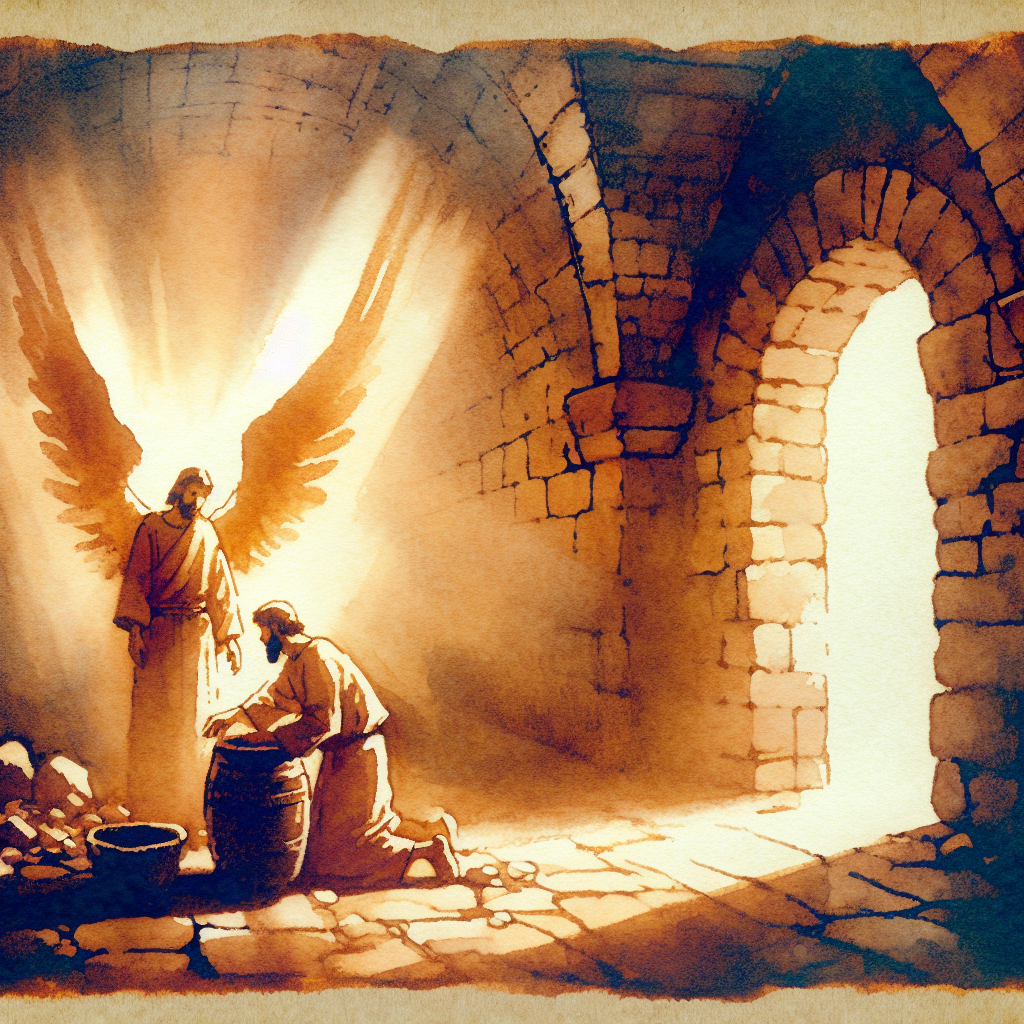
The Angel in the Prison: Acts 12:1-19
It was about this time that King Herod arrested some who belonged to the church, intending to persecute them.
Herod Agrippa I—grandson of Herod the Great, friend of emperors, king of the Jews. He saw political advantage in persecuting the church. Some arrested. Persecution intended.
He had James, the brother of John, put to death with the sword.
James—one of the inner three, brother of John, son of thunder. Put to death with the sword. Beheaded. The first apostle martyred. One sentence covered his death.
When he saw that this met with approval among the Jews, he arrested Peter also.
Popular approval fueled more persecution. Peter arrested. The pattern seemed clear: James dead, Peter next.
This happened during the Festival of Unleavened Bread. After arresting him, he put him in prison, handing him over to be guarded by four squads of four soldiers each.
Maximum security. Sixteen soldiers in rotation. Four at a time—two chained to Peter, two at the door. The festival would pass, then the execution.
Herod intended to bring him out for public trial after the Passover.
After Passover. Public trial. Public execution. The holiday wouldn't be interrupted by blood.
So Peter was kept in prison, but the church was earnestly praying to God for him.
Two realities: Peter in prison, church in prayer. But indicates tension. Prison seemed stronger than prayer. Chains seemed more real than intercession.
The night before Herod was to bring him to trial, Peter was sleeping between two soldiers, bound with two chains, and sentries stood guard at the entrance.
The last night. Tomorrow: trial and death. Peter slept. Between two soldiers. Two chains. Guards at every door. And Peter slept—the peace of a man whose life was in God's hands.
Suddenly an angel of the Lord appeared and a light shone in the cell.
Suddenly—the word of divine interruption. An angel. Light flooding the dark cell. The supernatural breaking into the secured space.
He struck Peter on the side and woke him up. Quick, get up! he said, and the chains fell off Peter's wrists.
The angel struck him—Peter slept that soundly. Get up, quickly. And the chains—simply fell off. Metal opened. Bonds released. The impossible happened.
Then the angel said to him, Put on your clothes and sandals. And Peter did so. Wrap your cloak around you and follow me, the angel said.
Instructions given calmly. Get dressed. Sandals on. Cloak wrapped. Follow me. As if this were normal. As if prison breaks happened every day.
Peter followed him out of the prison, but he had no idea that what the angel was doing was really happening; he thought he was seeing a vision.
Peter followed, thinking he dreamed. It was too good, too strange, too impossible to be real. A vision, surely. He would wake up in chains.
They passed the first and second guards and came to the iron gate leading to the city. It opened for them by itself, and they went through it.
Guard one—passed. Guard two—passed. The iron gate—opened by itself. No key, no force, no alarm. The prison released its prisoner.
When they had walked the length of one street, suddenly the angel left him.
One street. Far enough. Then the angel vanished. As suddenly as he appeared, he was gone.
Then Peter came to himself and said, Now I know without a doubt that the Lord has sent his angel and rescued me from Herod's clutches and from everything the Jewish people were hoping would happen.
Reality sank in. Not a dream. Not a vision. Real streets, real cold, real freedom. The Lord sent his angel. Herod's clutches escaped. The people's hopes frustrated.
When this had dawned on him, he went to the house of Mary the mother of John, also called Mark, where many people had gathered and were praying.
He went to the prayer meeting. Mary's house—a gathering point for believers. Many people praying—for Peter, presumably. Their prayer was about to be answered at the door.
Peter knocked at the outer entrance, and a servant named Rhoda came to answer the door.
Peter knocked. Rhoda answered—a servant girl, remembered by name because of what happened next.
When she recognized Peter's voice, she was so overjoyed she ran back without opening the door and exclaimed, Peter is at the door!
She recognized his voice. Joy overwhelmed her. She forgot to open the door. Peter left knocking while she ran inside shouting the news.
You're out of your mind, they told her.
The praying people didn't believe her. You're crazy. We're praying for Peter's release, but he can't actually be at the door.
When she kept insisting that it was so, they said, It must be his angel.
She insisted. They compromised: his angel then. Not him. The man they prayed for stood outside while they debated inside.
But Peter kept on knocking, and when they opened the door and saw him, they were astonished.
He kept knocking. Finally someone opened. And astonishment—the prayer answered, standing on the doorstep, very much alive, very much free.
Peter motioned with his hand for them to be quiet and described how the Lord had brought him out of prison.
Shh—the neighbors might hear. Peter explained: the angel, the chains, the gates, the street. The Lord had done it.
Tell James and the other brothers and sisters about this, he said, and then he left for another place.
Tell James—the Lord's brother, now leading in Jerusalem. Peter went underground. Herod would be looking.
In the morning, there was no small commotion among the soldiers as to what had become of Peter.
No small commotion—understatement. The prisoner gone. Chains on the floor. Gates locked. No explanation. Herod's wrath would be terrible.
After Herod had a thorough search made for him and did not find him, he cross-examined the guards and ordered that they be executed.
The guards paid with their lives. Roman justice: the prisoner's escape cost the guards' heads.
Peter lived. James died. Prayer was answered—but not always in the same way. The church learned that God's rescues were sovereign, not predictable. But they prayed anyway.
Powered by ChurchWiseAI
This illustration is a preview of what our AI-powered ministry platform can do. ChurchWiseAI offers a full suite of tools built for pastors and church leaders.
Sermon Companion
Build entire sermons with AI — outlines, illustrations, application points, and slide decks tailored to your tradition.
Ministry Chatbot
An AI assistant trained on theology, counseling frameworks, and church administration to help with any ministry question.
Bible Study Builder
Generate discussion guides, devotionals, and small group materials from any passage — in minutes, not hours.
Try any app free for 7 days — no credit card required.
Get Started