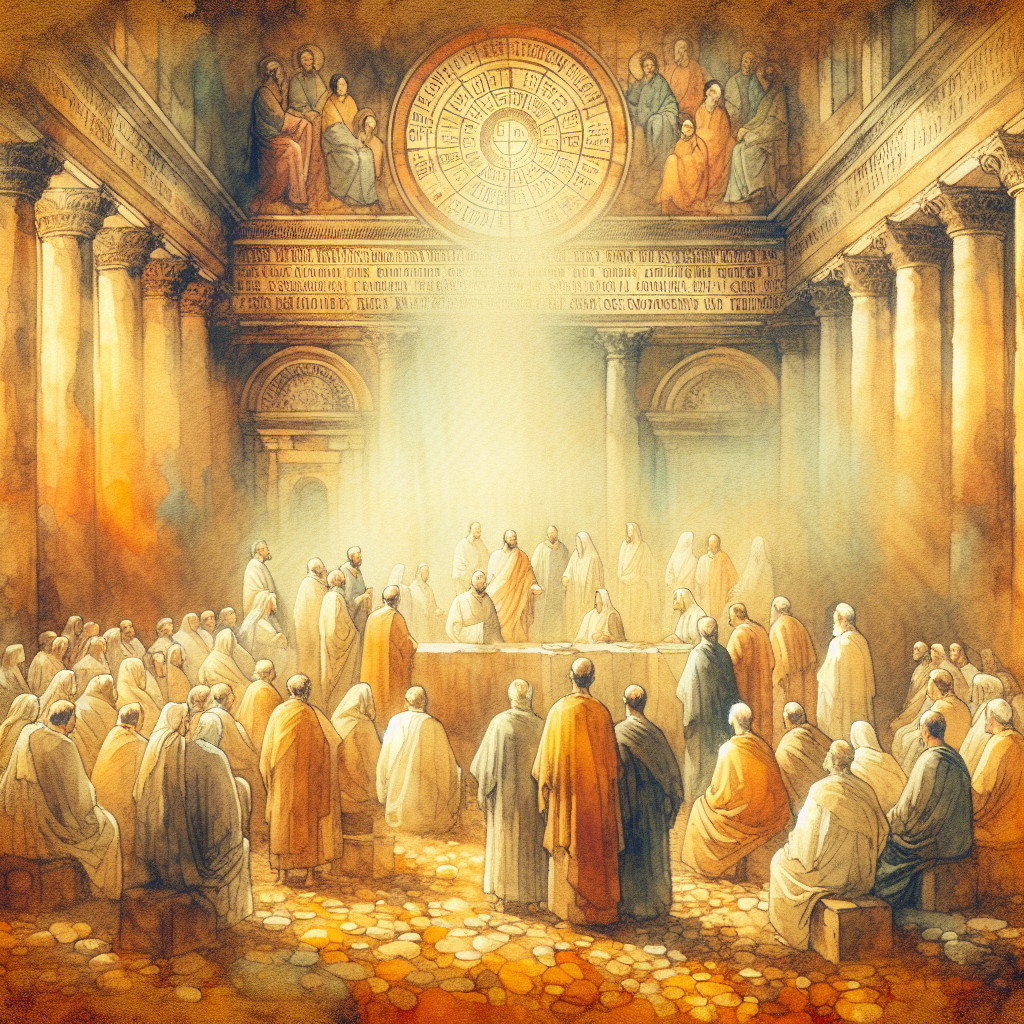
The Household of God: Widows, Elders, and Servants
The church in Ephesus is a household.
οἶκος θεοῦ—the house of God. And like any household in the ancient world, it contains multiple generations, multiple roles, multiple relationships that must be navigated with wisdom.
Timothy has questions. Paul provides guidance.
---
"Do not rebuke an older man harshly, but exhort him as if he were your father."
πρεσβυτέρῳ μὴ ἐπιπλήξῃς—do not strike at an elder. The verb carries violence: hitting, striking, attacking. Even when correction is needed, respect for age shapes the approach.
"Treat younger men as brothers, older women as mothers, and younger women as sisters, with absolute purity."
The family metaphor governs everything. Fathers. Brothers. Mothers. Sisters. The categories shape behavior. Young women especially: with all purity. ἐν πάσῃ ἁγνείᾳ. Timothy is a young man; scandal lurks in carelessness.
---
The widows.
In a world without pensions, without social security, without inheritance rights for women in many cases, widows were vulnerable. The church must care for them. But how?
"Give proper recognition to those widows who are really in need."
τίμα—honor. χήρας τὰς ὄντως χήρας—widows who are really widows. The repetition signals a distinction. Not every woman whose husband has died qualifies for church support.
"But if a widow has children or grandchildren, these should learn first of all to put their religion into practice by caring for their own family and so repaying their parents and grandparents, for this is pleasing to God."
Family first. Children and grandchildren bear primary responsibility. To neglect aging parents while the church picks up the tab—this inverts God's order. εὐσεβεῖν—to show proper piety—begins at home.
"The widow who is really in need and left all alone puts her hope in God and continues night and day to pray and to ask God for help."
The true widow: alone, hopeful, prayerful. μεμονωμένη—isolated, solitary. No family to care for her. She depends on God, and the church becomes God's hands.
"But the widow who lives for pleasure is dead even while she lives."
σπαταλῶσα—living in luxury, in self-indulgence. A widow who uses her freedom for sensuality rather than service—she lives biologically but not spiritually. The church need not support this.
"Anyone who does not provide for their relatives, and especially for their own household, has denied the faith and is worse than an unbeliever."
The harshest words in the passage. Neglecting family isn't just social failure—it's apostasy in action. ἤρνηται τὴν πίστιν—has denied the faith. Even pagans care for their own. Christians who don't are worse than unbelievers.
---
Paul provides criteria for the widow list:
"No widow may be put on the list of widows unless she is over sixty, has been faithful to her husband, and is well known for her good deeds."
Sixty years old. μὴ ἔλαττον ἐτῶν ἑξήκοντα. A specific threshold. One-husband faithfulness. Good works reputation.
What good works? Paul specifies: "...such as bringing up children, showing hospitality, washing the feet of the Lord's people, helping those in trouble and devoting herself to all kinds of good deeds."
A life poured out in service. Children raised. Strangers welcomed. Saints' feet washed—the humble work Jesus did at the last supper. Troubles addressed. Every opportunity seized.
"As for younger widows, do not put them on such a list. For when their sensual desires overcome their dedication to Christ, they want to marry."
Younger widows face different pressures. καταστρηνιάσωσιν τοῦ Χριστοῦ—when they grow wanton against Christ. Sexual desires reassert themselves. Marriage becomes attractive. And if they've pledged themselves to celibate service and then marry, they've broken faith.
"Besides, they get into the habit of being idle and going about from house to house. And not only do they become idlers, but also busybodies who talk nonsense, saying things they ought not to."
The social dynamics of ancient cities. Women without employment, supported by the church, visiting homes, spreading gossip. φλύαροι—babblers. περίεργοι—meddlers. λαλοῦσαι τὰ μὴ δέοντα—speaking what shouldn't be spoken.
"So I counsel younger widows to marry, to have children, to manage their homes and to give the enemy no opportunity for slander."
Marriage is the remedy. New households to manage. New children to raise. Purpose that prevents idleness. And protection against slander—ἀφορμὴν τῷ ἀντικειμένῳ λοιδορίας χάριν.
"Some have in fact already turned away to follow Satan."
ἐξετράπησαν ὀπίσω τοῦ Σατανᾶ. The problem isn't hypothetical. It's happened. Young widows, unsupervised and idle, drawn into destruction.
"If any woman who is a believer has widows in her care, she should continue to help them and not let the church be burdened with them, so that the church can help those widows who are really in need."
Private charity where possible. Church resources for the truly needy. The goal: μόναις—the truly alone.
---
The elders.
"The elders who direct the affairs of the church well are worthy of double honor, especially those whose work is preaching and teaching."
διπλῆς τιμῆς—double honor. The phrase suggests compensation, not just respect. οἱ κοπιῶντες ἐν λόγῳ καὶ διδασκαλίᾳ—those laboring in word and teaching. Preaching is work. It deserves support.
"For Scripture says, 'Do not muzzle an ox while it is treading out the grain,' and 'The worker deserves his wages.'"
Deuteronomy and Jesus, quoted together. The ox illustration: let the working animal eat. The direct statement: pay workers.
"Do not entertain an accusation against an elder unless it is brought by two or three witnesses."
Protection for leaders. Accusations fly easily. ἐκτὸς εἰ μὴ ἐπὶ δύο ἢ τριῶν μαρτύρων—except on the basis of multiple witnesses. One disgruntled person cannot destroy a leader's reputation.
"But those elders who are sinning you are to reprove before everyone, so that the others may take warning."
When sin is established, public rebuke. ἐνώπιον πάντων ἔλεγχε—reprove before all. The same visibility that protected innocent leaders now exposes guilty ones. Others watching learn: sin has consequences.
"I charge you, in the sight of God and Christ Jesus and the elect angels, to keep these instructions without partiality, and to do nothing out of favoritism."
The most solemn charge in the letter. God watching. Christ watching. Angels watching. No προκρίματος—prejudice. No πρόσκλισιν—favoritism. Equal treatment for all.
"Do not be hasty in the laying on of hands, and do not share in the sins of others. Keep yourself pure."
χεῖρας ταχέως μηδενὶ ἐπιτίθει—don't lay hands quickly. Ordination shouldn't be rushed. A hasty appointment makes you complicit in the appointee's eventual failures.
"Stop drinking only water, and use a little wine because of your stomach and your frequent illnesses."
A personal aside. Timothy apparently has stomach troubles and drinks only water—perhaps from ascetic scruples, perhaps from caution. Paul says: a little wine is medicinal. Ὀλίγῳ οἴνῳ χρῶ. Health matters.
"The sins of some are obvious, reaching the place of judgment ahead of them; the sins of others trail behind them. In the same way, good deeds are obvious, and even those that are not obvious cannot remain hidden forever."
A proverb for the patient. Some sins are immediately visible; judgment is obvious. Others hide longer but eventually surface. The same for good deeds: some obvious, some hidden—but nothing stays hidden forever.
---
The slaves.
"All who are under the yoke of slavery should consider their masters worthy of full respect, so that God's name and our teaching may not be slandered."
ὑπὸ ζυγόν δοῦλοι—slaves under the yoke. The metaphor is agricultural: oxen yoked for work. Paul doesn't dismantle the institution but addresses those within it. Full respect for masters—so that the gospel isn't blamed for social disorder.
"Those who have believing masters should not show them disrespect just because they are fellow believers. Instead, they should serve them even better because their masters are dear to them as fellow believers and are devoted to the welfare of their slaves."
Christian slaves with Christian masters face a particular temptation: to presume on spiritual equality. We're siblings in Christ, so why should I obey? Paul reverses the logic: precisely because your master is a believer, serve him better. The relationship of faith doesn't erase the relationship of work.
---
Timothy sets down the letter.
The household of God is complicated. Widows young and old. Elders worthy and sinning. Slaves and masters navigating dual loyalties.
No one-size-fits-all solution. Wisdom required at every turn. But the principles are clear:
Family first, church as backup.
Leaders protected and accountable.
Service shaped by context, not resentment.
The household must be managed well.
Creative Approach
historical_reconstruction
Powered by ChurchWiseAI
This illustration is a preview of what our AI-powered ministry platform can do. ChurchWiseAI offers a full suite of tools built for pastors and church leaders.
Sermon Companion
Build entire sermons with AI — outlines, illustrations, application points, and slide decks tailored to your tradition.
Ministry Chatbot
An AI assistant trained on theology, counseling frameworks, and church administration to help with any ministry question.
Bible Study Builder
Generate discussion guides, devotionals, and small group materials from any passage — in minutes, not hours.
Try any app free for 7 days — no credit card required.
Get Started