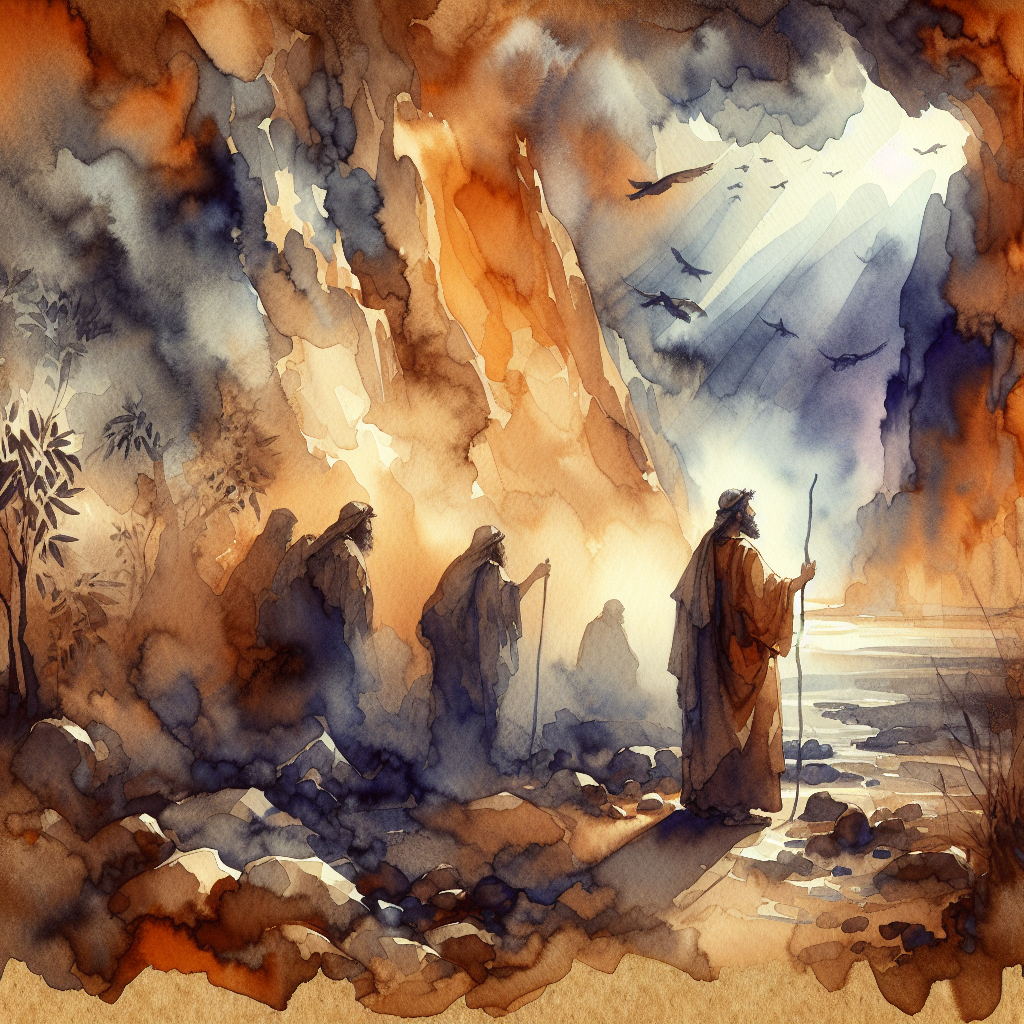
The Pit and the Price: Genesis 37:12-36
Now his brothers had gone to graze their father's flocks near Shechem, and Israel said to Joseph, "As you know, your brothers are grazing the flocks near Shechem. Come, I am going to send you to them."
"Very well," he replied.
A simple errand. Check on the brothers, bring back a report. Joseph set out, wearing his famous coat, walking into a trap.
So he said to him, "Go and see if all is well with your brothers and with the flocks, and bring word back to me." Then he sent him off from the Valley of Hebron.
When Joseph arrived at Shechem, a man found him wandering around in the fields and asked him, "What are you looking for?"
He replied, "I'm looking for my brothers. Can you tell me where they are grazing their flocks?"
"They have moved on from here," the man answered. "I heard them say, 'Let's go to Dothan.'"
So Joseph went after his brothers and found them near Dothan.
Dothan—about fifteen miles farther. Joseph tracked them down, the dutiful younger brother in his coat of many colors, visible from a distance.
But they saw him in the distance, and before he reached them, they plotted to kill him.
They saw him coming. The coat was recognizable, the dreamer unmistakable. And the hatred that had been simmering boiled over into murder plot.
"Here comes that dreamer!" they said to each other. "Come now, let's kill him and throw him into one of these cisterns and say that a ferocious animal devoured him. Then we'll see what comes of his dreams."
Then we'll see what comes of his dreams. The motive was clear—destroy the dreamer, destroy the dream.
When Reuben heard this, he tried to rescue him from their hands. "Let's not take his life," he said. "Don't shed any blood. Throw him into this cistern here in the wilderness, but don't lay a hand on him."
Reuben, the firstborn, tried to save him—planning to return later and pull Joseph out. A half-rescue. A compromise with evil.
So when Joseph came to his brothers, they stripped him of his robe—the ornate robe he was wearing—and they took him and threw him into the cistern.
They stripped him. The coat came off first—the symbol of their father's favoritism torn away. Then Joseph went into the pit: empty, waterless, dark.
As they sat down to eat their meal, they looked up and saw a caravan of Ishmaelites coming from Gilead.
They sat down to eat. Their brother in a hole, crying out, and they ate lunch. The casualness of their cruelty is staggering.
Their camels were loaded with spices, balm and myrrh, and they were on their way to take them down to Egypt.
Ishmaelites—descendants of Hagar, Abraham's other line—heading to Egypt with trade goods. Providence was arranging the pieces.
Judah said to his brothers, "What will we gain if we kill our brother and cover up his blood? Come, let's sell him to the Ishmaelites and not lay our hands on him; after all, he is our brother, our own flesh and blood." His brothers agreed.
Judah's proposal. Not mercy but profit—why waste a brother when you could sell him? Twenty shekels of silver changed hands.
So when the Midianite merchants came by, his brothers pulled Joseph up out of the cistern and sold him for twenty shekels of silver to the Ishmaelites, who took him to Egypt.
Twenty shekels. The price of a teenage slave. Joseph—son of the patriarch, receiver of divine dreams—sold like livestock.
When Reuben returned to the cistern and saw that Joseph was not there, he tore his clothes. He went back to his brothers and said, "The boy isn't there! Where can I turn now?"
Reuben's horror. His rescue plan had failed. The brothers had acted while he was away.
Then they got Joseph's robe, slaughtered a goat and dipped the robe in the blood. They took the ornate robe back to their father and said, "We found this. Examine it to see whether it is your son's robe."
Goat's blood. The deceiver Jacob had used goatskins to deceive his father; now his sons used goat blood to deceive him. The sins of the fathers echoed in the sons.
He recognized it and said, "It is my son's robe! Some ferocious animal has devoured him. Joseph has surely been torn to pieces."
Jacob believed the lie. His favorite son, dead. The coat that had marked Joseph as beloved now testified to his destruction.
Then Jacob tore his clothes, put on sackcloth and mourned for his son many days. All his sons and daughters came to comfort him, but he refused to be comforted. "No," he said, "I will continue to mourn until I join my son in the grave." So his father wept for him.
The brothers watched their father weep—the very brothers who had caused the grief. They offered false comfort for a false death.
Meanwhile, the Midianites sold Joseph in Egypt to Potiphar, one of Pharaoh's officials, the captain of the guard.
Meanwhile. While Jacob wept in Canaan, Joseph arrived in Egypt. Slave block. New master. A household that belonged to Pharaoh's captain of the guard.
The dreamer had fallen from the pit to the auction. But the dreams were still true. The God who gave them was still watching.
Egypt would be Joseph's crucible. The pit was only the beginning.
Powered by ChurchWiseAI
This illustration is a preview of what our AI-powered ministry platform can do. ChurchWiseAI offers a full suite of tools built for pastors and church leaders.
Sermon Companion
Build entire sermons with AI — outlines, illustrations, application points, and slide decks tailored to your tradition.
Ministry Chatbot
An AI assistant trained on theology, counseling frameworks, and church administration to help with any ministry question.
Bible Study Builder
Generate discussion guides, devotionals, and small group materials from any passage — in minutes, not hours.
Try any app free for 7 days — no credit card required.
Get Started