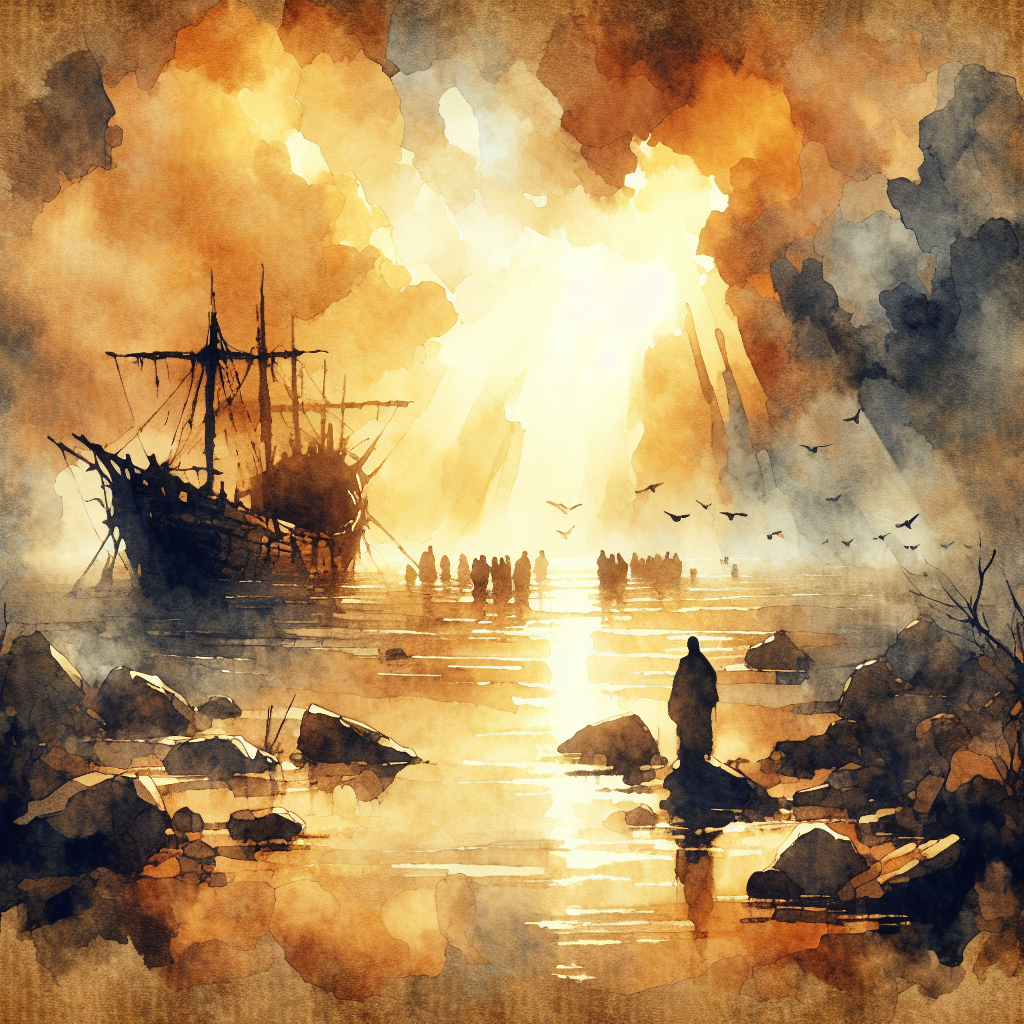
The Storm and the Shipwreck: Acts 27:13-44
When a gentle south wind began to blow, they saw their opportunity; so they weighed anchor and sailed along the shore of Crete.
The journey to Rome had begun badly. Late season sailing. Contrary winds. But a gentle south wind appeared—their chance. They sailed from Fair Havens, hoping to reach a better harbor.
Before very long, a wind of hurricane force, called the Northeaster, swept down from the island.
Before very long—the gentle wind became a monster. Hurricane force—the Greek word typhonikos gives us typhoon. The Northeaster—a famous killer of ships. Sudden, violent, inescapable.
The ship was caught by the storm and could not head into the wind; so we gave way to it and were driven along.
No control. The ship surrendered to the storm. Driven along—not sailing but surviving.
We took such a violent battering from the storm that the next day they began to throw the cargo overboard.
Day two. Violent battering. Cargo overboard—the cargo that was the voyage's purpose. Survival trumped profit.
On the third day, they threw the ship's tackle overboard with their own hands.
Day three. The ship's tackle—the equipment, the rigging. With their own hands—everyone working. Desperate measures.
When neither sun nor stars appeared for many days and the storm continued raging, we finally gave up all hope of being saved.
Many days. No sun, no stars—no navigation possible. Storm raging without ceasing. Hope abandoned. Two hundred seventy-six souls waiting to die.
After they had gone a long time without food, Paul stood up before them and said: Men, you should have taken my advice not to sail from Crete; then you would have spared yourselves this damage and loss.
Paul spoke. He had warned them. They hadn't listened. Now he had more to say.
But now I urge you to keep up your courage, because not one of you will be lost; only the ship will be destroyed.
Courage. The promise: no lives lost. The ship—yes, destroyed. But every person—saved.
Last night an angel of the God to whom I belong and whom I serve stood beside me and said, Do not be afraid, Paul. You must stand trial before Caesar; and God has graciously given you the lives of all who sail with you.
The angel's visit. Paul belonged to God. Paul served God. And God spoke: Don't fear. You will stand before Caesar. And all these people—given to you. Their lives preserved because of Paul's mission.
So keep up your courage, men, for I have faith in God that it will happen just as he told me.
Faith declared. It will happen. Just as God said.
Nevertheless, we must run aground on some island.
The prophecy complete: run aground somewhere. Not open sea death but island arrival.
On the fourteenth night we were still being driven across the Adriatic Sea, when about midnight the sailors sensed they were approaching land.
Fourteen nights. Driven across the sea. Midnight. The sailors sensed land—perhaps the sound of surf, perhaps the smell of shore.
They took soundings and found that the water was a hundred and twenty feet deep. A short time later they took soundings again and found it was ninety feet deep.
Soundings confirmed: land approaching. Water shallowing. Ninety feet and dropping.
Fearing that we would be dashed against the rocks, they dropped four anchors from the stern and prayed for daylight.
Four anchors. Stern first—to keep the bow pointed toward shore. And prayer—for daylight to see what they faced.
In an attempt to escape from the ship, the sailors let the lifeboat down into the sea, pretending they were going to lower some anchors from the bow.
The sailors tried to escape. Lowering the lifeboat. Pretending to work. Planning to abandon ship and passengers.
Then Paul said to the centurion and the soldiers, Unless these men stay with the ship, you cannot be saved.
Paul saw through it. He warned the centurion. These sailors were needed. Without them, the promise couldn't be fulfilled.
So the soldiers cut the ropes that held the lifeboat and let it drift away.
The soldiers acted decisively. Cut the ropes. The lifeboat drifted off. No escape now—everyone committed.
Just before dawn Paul urged them all to eat. For the last fourteen days, he said, you have been in constant suspense and have gone without food—you haven't eaten anything.
Fourteen days without food. Suspense and storm draining them. Paul urged: eat. You'll need strength.
Now I urge you to take some food. You need it to survive. Not one of you will lose a single hair from his head.
Not a hair lost. The promise repeated. Now eat.
After he said this, he took some bread and gave thanks to God in front of them all. Then he broke it and began to eat.
Paul modeled it. Bread taken. Thanks given—in front of pagans, prisoners, soldiers. Bread broken. Eating begun.
They were all encouraged and ate some food themselves. Altogether there were 276 of us on board.
Encouraged. All ate. Luke counted: 276 people. Every one would survive.
When they had eaten as much as they wanted, they lightened the ship by throwing the grain into the sea.
The last cargo—grain, the reason for the voyage—thrown overboard. The ship stripped for its final run.
When daylight came, they did not recognize the land, but they saw a bay with a sandy beach, where they decided to run the ship aground if they could.
Dawn revealed land—unfamiliar. But a bay appeared. Sandy beach. Their target.
Cutting loose the anchors, they left them in the sea and at the same time untied the ropes that held the rudders. Then they hoisted the foresail to the wind and made for the beach.
Anchors cut. Rudders freed. Foresail raised. Heading for the beach.
But the ship struck a sandbar and ran aground. The bow stuck fast and would not move, and the stern was broken to pieces by the pounding of the surf.
Sandbar. The bow stuck. The stern exposed to the surf. Waves pounding. The ship breaking apart.
The soldiers planned to kill the prisoners to prevent any of them from swimming away and escaping.
Roman logic: prisoners must not escape. Kill them now before they swim.
But the centurion wanted to spare Paul's life and kept them from carrying out their plan.
The centurion intervened—for Paul's sake. The prisoners would live.
He ordered those who could swim to jump overboard first and get to land. The rest were to get there on planks or on other pieces of the ship.
Swimmers first. Then planks. Debris as life rafts. Everyone into the water.
In this way everyone reached land safely.
Everyone. Two hundred seventy-six souls. Not one lost. Just as the angel said. Just as Paul believed.
The ship destroyed. The cargo lost. But every person—saved. Paul would stand before Caesar. God's word proved true in the middle of the Mediterranean.
Powered by ChurchWiseAI
This illustration is a preview of what our AI-powered ministry platform can do. ChurchWiseAI offers a full suite of tools built for pastors and church leaders.
Sermon Companion
Build entire sermons with AI — outlines, illustrations, application points, and slide decks tailored to your tradition.
Ministry Chatbot
An AI assistant trained on theology, counseling frameworks, and church administration to help with any ministry question.
Bible Study Builder
Generate discussion guides, devotionals, and small group materials from any passage — in minutes, not hours.
Try any app free for 7 days — no credit card required.
Get Started