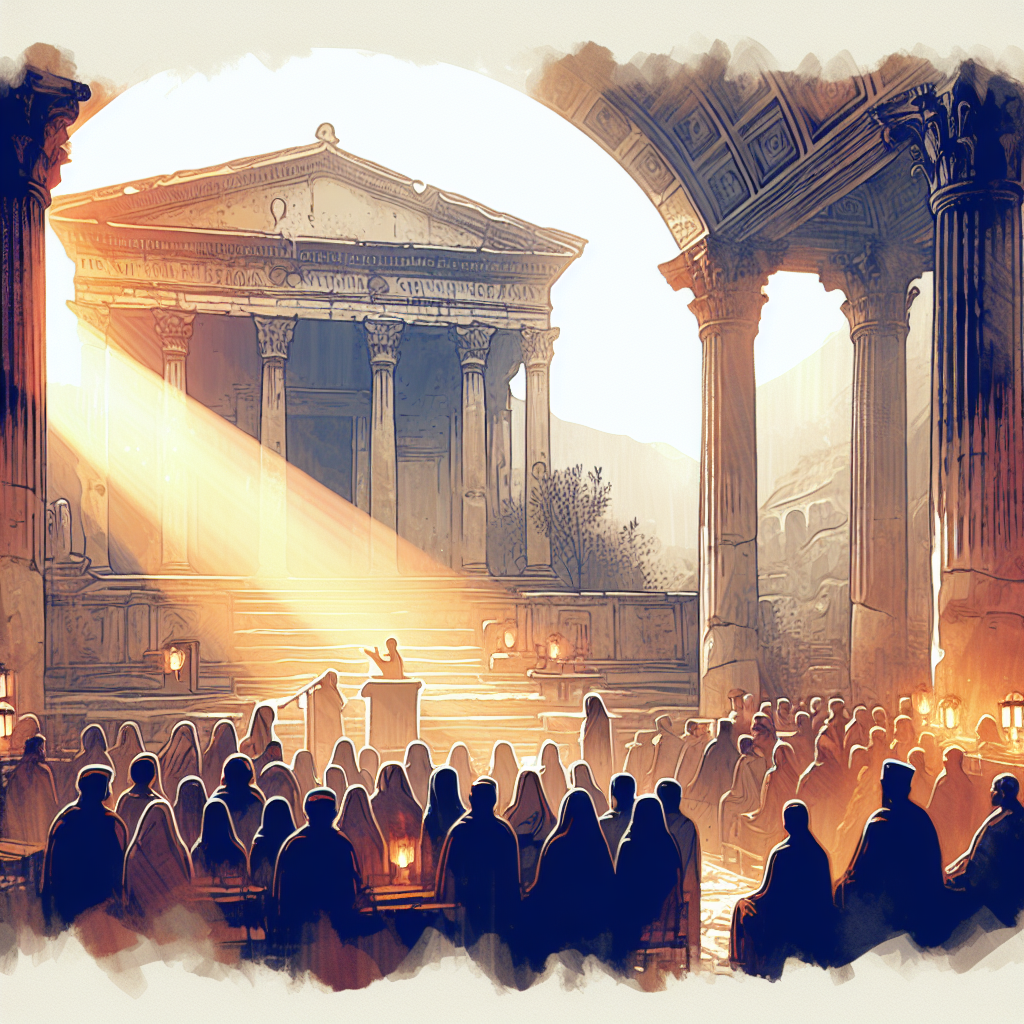
The Unknown God: Acts 17:16-34
While Paul was waiting for them in Athens, he was greatly distressed to see that the city was full of idols.
Athens—the intellectual capital of the ancient world. Philosophy born here. Democracy invented here. And idols everywhere. Paul was distressed—the Greek suggests provoked, stirred to anger. The city of Socrates was also the city of countless gods.
So he reasoned in the synagogue with both Jews and God-fearing Greeks, as well as in the marketplace day by day with those who happened to be there.
Paul engaged everywhere. Synagogue for Jews and seekers. Marketplace—the agora—for anyone passing. Day by day. Reasoning, discussing, debating.
A group of Epicurean and Stoic philosophers began to debate with him.
The philosophical schools noticed. Epicureans—seeking pleasure, avoiding pain, denying divine involvement. Stoics—seeking virtue, accepting fate, believing in divine reason. Both curious about this strange Jew.
Some of them asked, What is this babbler trying to say?
Babbler—spermologos, a seed-picker, a bird grabbing scraps. Intellectual contempt. What is this amateur saying?
Others remarked, He seems to be advocating foreign gods.
Foreign gods—plural. They had misunderstood.
They said this because Paul was preaching the good news about Jesus and the resurrection.
Jesus and anastasis—resurrection. They thought resurrection was a goddess. Two foreign deities: Jesus and Anastasis.
Then they took him and brought him to a meeting of the Areopagus, where they said to him, May we know what this new teaching is that you are presenting?
The Areopagus—Mars Hill—the court that evaluated new ideas and new religions. Official hearing. Intellectual curiosity dressed in procedural robes.
You are bringing some strange ideas to our ears, and we would like to know what they mean.
Strange ideas. We want to understand. Athens collected ideas the way others collected coins.
(All the Athenians and the foreigners who lived there spent their time doing nothing but talking about and listening to the latest ideas.)
Luke's editorial comment. Athens loved novelty. Always discussing, always listening, always seeking the new thing.
Paul then stood up in the meeting of the Areopagus and said: People of Athens! I see that in every way you are very religious.
Paul stood. Addressed them respectfully. Very religious—the word could mean religious or superstitious. Paul chose the diplomatic meaning.
For as I walked around and looked carefully at your objects of worship, I even found an altar with this inscription: TO AN UNKNOWN GOD. So you are ignorant of the very thing you worship—and this is what I am going to proclaim to you.
The hook. An altar he had seen. To an unknown god—covering their bases, worshiping what they might have missed. Your unknown god—I will reveal him.
The God who made the world and everything in it is the Lord of heaven and earth and does not live in temples built by human hands.
The Creator God. Made everything. Lord of all. Not contained in temples. The Parthenon towered above them, but God wasn't in it.
And he is not served by human hands, as if he needed anything. Rather, he himself gives everyone life and breath and everything else.
God needs nothing. Humans can't supply God's lack. Instead, God gives—life, breath, everything. The direction of service reversed.
From one man he made all the nations, that they should inhabit the whole earth; and he marked out their appointed times in history and the boundaries of their lands.
One origin—all humanity from one ancestor. Nations scattered by divine design. Times and boundaries set. History orchestrated.
God did this so that they would seek him and perhaps reach out for him and find him, though he is not far from any one of us.
The purpose of history: seeking God. Reaching out. Finding. And the promise: he's not far. Not distant, not absent, but near.
For in him we live and move and have our being.
In him—the location of existence. We live in God. Move in God. Have our being in God. Not far indeed.
As some of your own poets have said, We are his offspring.
Paul quoted their poets. Aratus, Cleanthes—Greek writers. We are his offspring. Common ground. Even your poets glimpsed this.
Therefore since we are God's offspring, we should not think that the divine being is like gold or silver or stone—an image made by human design and skill.
The conclusion drawn. If we are God's children, God is not metal or stone. The idol-makers had it backward. God doesn't look like our sculptures; we are meant to look like him.
In the past God overlooked such ignorance, but now he commands all people everywhere to repent.
Patience past. Command present. All people, everywhere. Repent—turn around. The unknown God was making himself known and demanding response.
For he has set a day when he will judge the world with justice by the man he has appointed.
Judgment coming. A day set. Justice promised. A man appointed—not named yet.
He has given proof of this to everyone by raising him from the dead.
The proof: resurrection. The appointed judge raised from the dead. The claim that made Christianity unique.
When they heard about the resurrection of the dead, some of them sneered, but others said, We want to hear you again on this subject.
The response divided. Sneering—the resurrection was foolishness to Greek ears. But some wanted more. The marketplace of ideas had heard something new.
At that, Paul left the Council. Some of the people became followers of Paul and believed. Among them was Dionysius, a member of the Areopagus, also a woman named Damaris, and a number of others.
Not a mass conversion. Not a revival. But some believed. Dionysius—a council member. Damaris—a woman remembered by name. Others. The seed planted in philosophical soil.
Athens heard the gospel. The unknown God had a name. Some sneered. Some believed. Paul moved on.
Powered by ChurchWiseAI
This illustration is a preview of what our AI-powered ministry platform can do. ChurchWiseAI offers a full suite of tools built for pastors and church leaders.
Sermon Companion
Build entire sermons with AI — outlines, illustrations, application points, and slide decks tailored to your tradition.
Ministry Chatbot
An AI assistant trained on theology, counseling frameworks, and church administration to help with any ministry question.
Bible Study Builder
Generate discussion guides, devotionals, and small group materials from any passage — in minutes, not hours.
Try any app free for 7 days — no credit card required.
Get Started