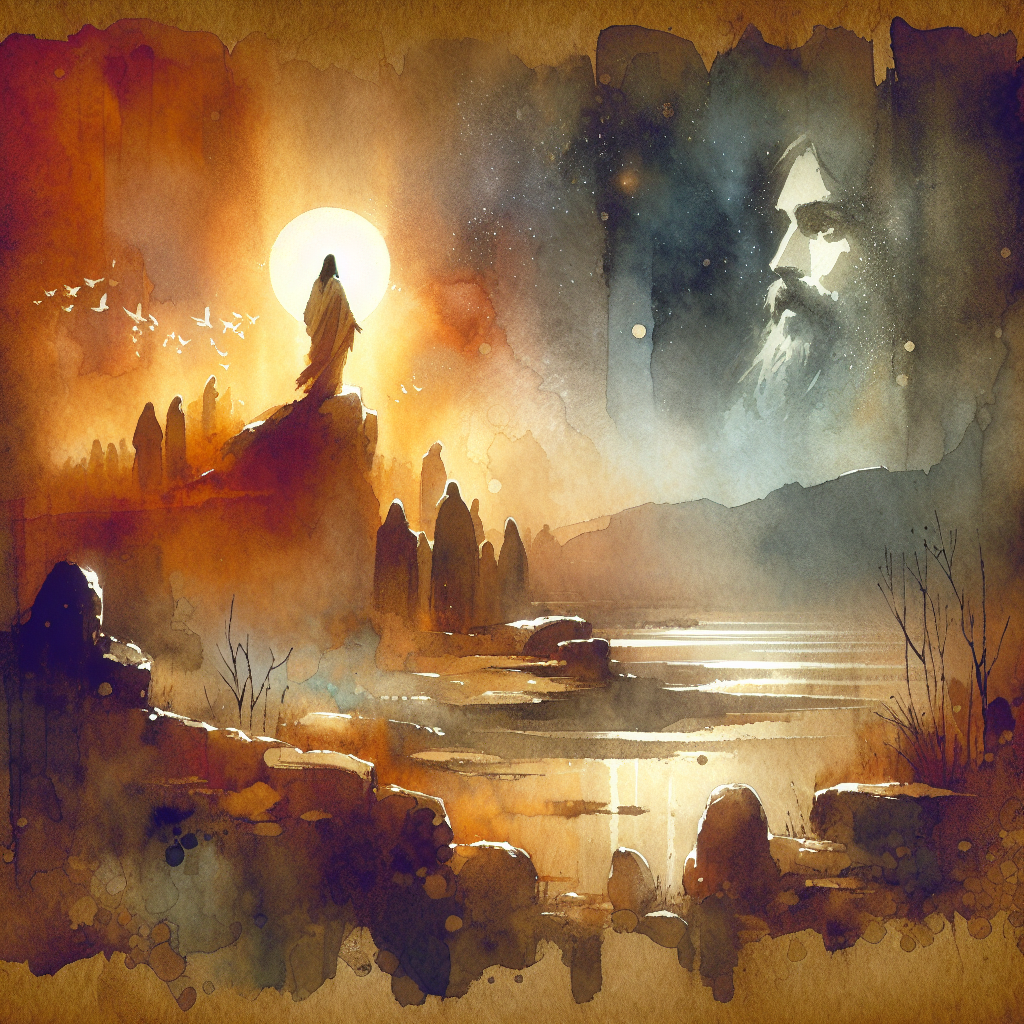
The Word Became Flesh: John 1:1-18
In the beginning was the Word, and the Word was with God, and the Word was God.
In the beginning. John reaches back before Bethlehem, before creation, before time itself. The opening echoes Genesis—in the beginning—but goes further. Before anything was made, the Word already was.
The Word—Logos in Greek. Reason, expression, communication. God's self-revelation, his articulate presence. And this Word was with God—distinct personhood, face-to-face relationship. And the Word was God—full deity, not lesser divinity.
He was with God in the beginning.
The relationship was eternal. Never a time when the Word began. Never a moment when the Word was alone.
Through him all things were made; without him nothing was made that has been made.
Creation flowed through the Word. Every star, every cell, every subatomic particle—made through him. Nothing escaped his creative agency. The Word is not creature; the Word is Creator.
In him was life, and that life was the light of all mankind.
Life resided in the Word—not received from elsewhere but intrinsic, essential. And this life shone as light for humanity. The source of existence was also the source of illumination.
The light shines in the darkness, and the darkness has not overcome it.
Present tense: shines. The light persists. And the darkness—moral, spiritual, cosmic darkness—has not overcome it. The word can mean understood or conquered. Either way, darkness loses.
There was a man sent from God whose name was John.
The prologue pauses for the forerunner. John the Baptist, sent by God, arriving at the right moment.
He came as a witness to testify concerning that light, so that through him all might believe.
Witness. Testimony. John's role was to point, not to be the destination. His purpose was faith in another.
He himself was not the light; he came only as a witness to the light.
John was not the light. The clarification mattered—some had followed John as if he were the final word. He was not. He was voice, not word; finger pointing, not destination.
The true light that gives light to everyone was coming into the world.
True light—genuine, ultimate, authentic. Coming into the world—incarnation approaching. Light for everyone—not Israel only, not the righteous only. Universal illumination.
He was in the world, and though the world was made through him, the world did not recognize him.
Tragic irony. The world exists because of him, through him. Yet when he walked its roads, the world failed to recognize its maker.
He came to that which was his own, but his own did not receive him.
His own—Israel, the chosen people, the covenant community. They should have recognized him. They did not receive him.
Yet to all who did receive him, to those who believed in his name, he gave the right to become children of God.
Yet. The rejection was not total. Some received. Some believed. And to them—Jew and Gentile, insider and outsider—he gave the right to become God's children.
Children born not of natural descent, nor of human decision or a husband's will, but born of God.
This birth was not biological. Not bloodline, not human willing, not family planning. Born of God—spiritual regeneration, divine initiative.
The Word became flesh and made his dwelling among us.
The climax of the prologue. The eternal Word, the divine Creator, became flesh—sarx, meat, muscle, mortality. Made his dwelling—literally, pitched his tent among us. The tabernacle presence of God, now in human form.
We have seen his glory, the glory of the one and only Son, who came from the Father, full of grace and truth.
Glory visible. The disciples saw it—in miracles, in teaching, in death and resurrection. Glory of the one and only—unique, singular, incomparable. Grace and truth together—mercy and reality combined.
John testified concerning him. He cried out, saying, This is the one I spoke about when I said, He who comes after me has surpassed me because he was before me.
John's testimony continued. The one who came after John in time was before John in existence. The infant born six months after John was eternal before John existed.
Out of his fullness we have all received grace in place of grace already given.
Grace upon grace. Waves of grace, layers of grace, grace replacing grace in endless supply. From his fullness—inexhaustible resources flowing to empty recipients.
For the law was given through Moses; grace and truth came through Jesus Christ.
Moses brought law. Jesus brought grace and truth. Not opposing but completing. Law through servant; grace through Son.
No one has ever seen God, but the one and only Son, who is himself God and is in closest relationship with the Father, has made him known.
No one has ever seen God. The divine nature remains invisible. But the Son—himself God, in the Father's embrace—has made him known. The invisible God has a visible face: Jesus.
The prologue ends where incarnation begins. The Word who was with God, who was God, became flesh and walked among us.
This is the Gospel of John's thesis statement. Everything that follows is commentary on these eighteen verses.
Powered by ChurchWiseAI
This illustration is a preview of what our AI-powered ministry platform can do. ChurchWiseAI offers a full suite of tools built for pastors and church leaders.
Sermon Companion
Build entire sermons with AI — outlines, illustrations, application points, and slide decks tailored to your tradition.
Ministry Chatbot
An AI assistant trained on theology, counseling frameworks, and church administration to help with any ministry question.
Bible Study Builder
Generate discussion guides, devotionals, and small group materials from any passage — in minutes, not hours.
Try any app free for 7 days — no credit card required.
Get Started