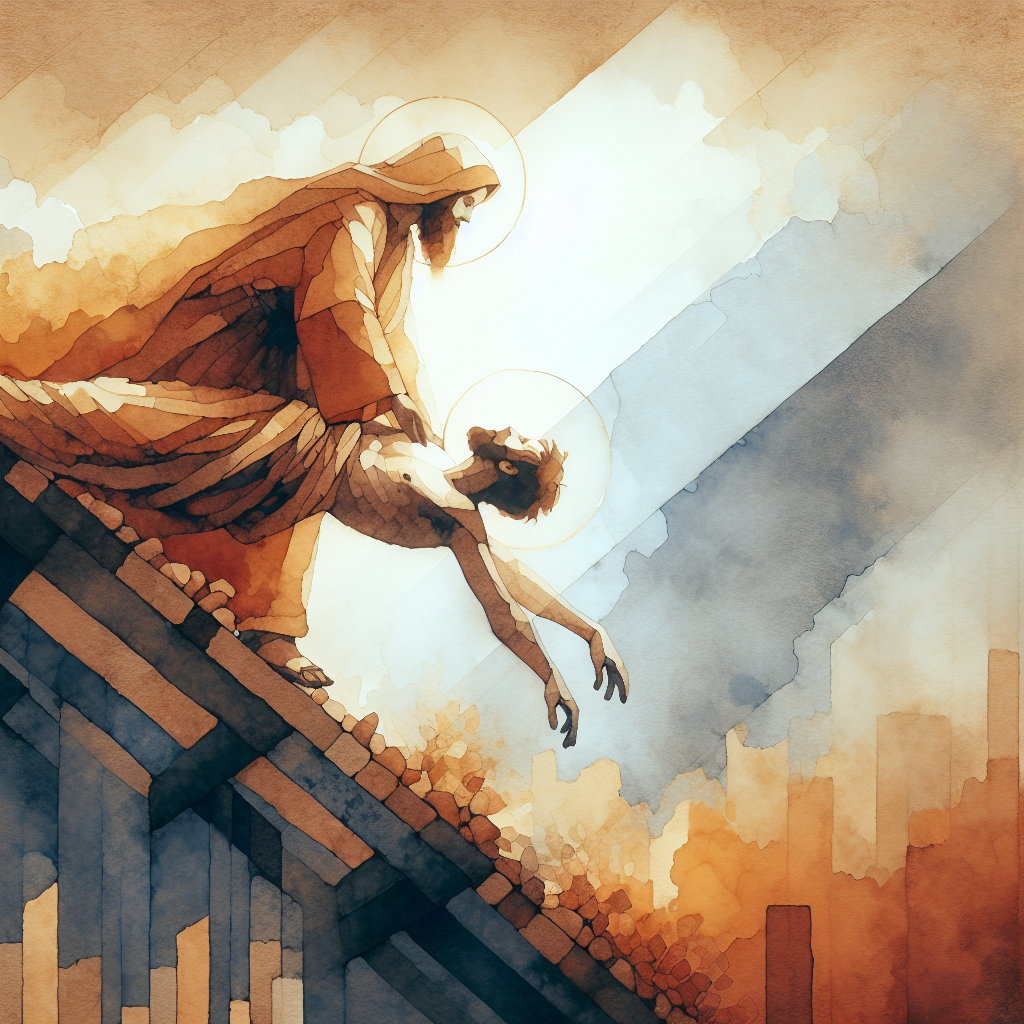
Through the Roof: Mark 2:1-12
The house was suffocating. Bodies packed the doorway three deep, faces pressed against windows, voices straining to hear. Somewhere inside, Jesus was teaching, but most of the crowd could only catch fragments. The religious scholars had claimed the best seats, of course—Pharisees and teachers of the law who had traveled from Jerusalem to investigate this Galilean phenomenon.
Outside, four men arrived carrying their friend on a mat. The paralytic had not walked in years. His legs were withered, useless; his arms could barely grip the pallet's edge. But his friends had carried him through the streets, certain that if they could just get him to Jesus—
The crowd would not move. They begged. They pleaded. No one budged.
So they went up.
The exterior stairs led to the flat roof, and the men climbed them, hauling their friend's dead weight step by step, sweat soaking their tunics. The roof was made of wooden beams covered with packed mud and branches. They began to dig.
Inside, Jesus was mid-sentence when debris began falling. Dust first, then chunks of dried mud, then suddenly daylight where there should have been ceiling. The scholars sputtered, brushing dirt from their robes. The crowd craned upward. Through the ragged hole, four determined faces appeared, and then—slowly, carefully—a man on a mat descended on ropes into the middle of the room.
Jesus looked up at the faces in the roof. He saw their faith. Not the paralytic's faith—his friends' faith. The faith that tears through obstacles.
"Son," Jesus said to the man on the mat, "your sins are forgiven."
The scholars stiffened. Their thoughts screamed louder than words: Blasphemy! Only God can forgive sins!
Jesus turned to them, and his eyes were knowing. "Why are you thinking these things? Which is easier: to say 'Your sins are forgiven,' or to say 'Get up and walk'?" The room held its breath. "But so that you may know that the Son of Man has authority on earth to forgive sins—"
He looked at the paralytic.
"Get up, take your mat, and go home."
The man's legs moved. Muscles that had not fired in years contracted. He stood—shakily at first, then firmly. He bent down, rolled up the mat he had been carried on, and walked through the stunned crowd, out the door, into the street.
The house erupted. People praised God, voices overlapping in amazement: "We have never seen anything like this!"
Above, through the hole in the roof, four friends were laughing.
Powered by ChurchWiseAI
This illustration is a preview of what our AI-powered ministry platform can do. ChurchWiseAI offers a full suite of tools built for pastors and church leaders.
Sermon Companion
Build entire sermons with AI — outlines, illustrations, application points, and slide decks tailored to your tradition.
Ministry Chatbot
An AI assistant trained on theology, counseling frameworks, and church administration to help with any ministry question.
Bible Study Builder
Generate discussion guides, devotionals, and small group materials from any passage — in minutes, not hours.
Try any app free for 7 days — no credit card required.
Get Started