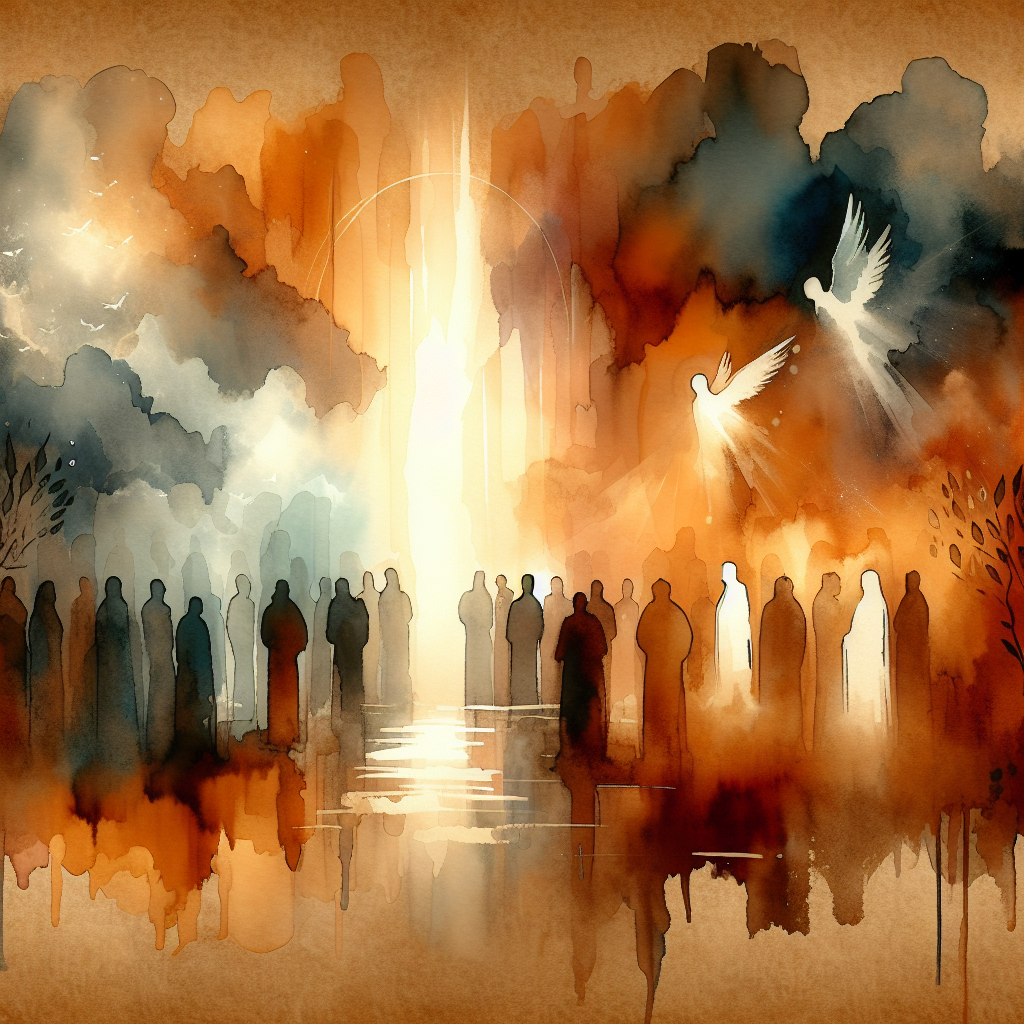
Two Adams, Two Humanities: Romans 5:12-21
Therefore, just as sin entered the world through one man, and death through sin, and in this way death came to all people, because all sinned.
One man. One act. One catastrophe.
The story of humanity begins with Adam, and Adam's story becomes our story. Sin entered—not created, but entered—through one man. A door opened that day in Eden, and through it came ruin.
Death through sin. Sin was not the only intruder. Death rode in on sin's coattails. The wages were set from the beginning: sin pays in death.
Death came to all people. Not just Adam. Not just Eve. All people. Every generation. Every nation. Every individual. Death came to all.
Because all sinned. The sentence is compressed, debated through centuries. In some way—by representation, by participation, by nature inherited—all sinned in Adam. His sin became ours. His death became ours.
To be sure, sin was in the world before the law was given, but sin is not charged against anyone's account where there is no law.
Sin existed before Sinai. People did wrong before Moses descended. But without law, there was no precise accounting. Sin was real but not formally charged.
Nevertheless, death reigned from the time of Adam to the time of Moses, even over those who did not sin by breaking a command, as did Adam, who is a pattern of the one to come.
Death reigned. The metaphor is royal—death sat on a throne, ruled over humanity. From Adam to Moses, before the law defined transgression, death still reigned. The proof that sin was real: everyone died.
Adam is a pattern. The word is typos—a type, a stamp, a foreshadowing. Adam pointed forward to another man. But the pattern would be reversed.
But the gift is not like the trespass.
Here the contrast begins. They are alike in structure—one man affecting many. But they are not alike in outcome.
For if the many died by the trespass of the one man, how much more did God's grace and the gift that came by the grace of the one man, Jesus Christ, overflow to the many!
How much more. The logic of abundance. If one man's trespass could bring death to many, how much more can God's grace bring life? The gift is greater than the trespass. Grace is more powerful than sin.
Overflow. The word is extravagant. Grace doesn't trickle—it overflows. It exceeds. It spills over the edges of what sin destroyed.
Nor can the gift of God be compared with the result of one man's sin: The judgment followed one sin and brought condemnation, but the gift followed many trespasses and brought justification.
The math doesn't balance. One sin brought condemnation—just one trespass and the verdict was rendered. But the gift followed many trespasses—countless sins, multiplied over millennia—and still brought justification.
Condemnation came quickly. Justification overcame more.
For if, by the trespass of the one man, death reigned through that one man, how much more will those who receive God's abundant provision of grace and of the gift of righteousness reign in life through the one man, Jesus Christ!
Death reigned through Adam. But those in Christ will reign in life. The throne changes hands. Death was king; now the redeemed are kings. Ruled over becomes ruling with.
Abundant provision. Grace heaped upon grace. Gift upon gift. The provision is more than adequate—it is abundant, lavish, overflowing.
Consequently, just as one trespass resulted in condemnation for all people, so also one righteous act resulted in justification and life for all people.
The parallel is precise. One trespass—condemnation for all. One righteous act—justification and life for all. Adam's sin judged humanity. Christ's obedience justifies humanity.
For just as through the disobedience of the one man the many were made sinners, so also through the obedience of the one man the many will be made righteous.
Disobedience and obedience. Adam disobeyed—took the fruit, broke the command, chose self over God. The many were made sinners—constituted as sinners, counted as sinners, ruined as sinners.
Christ obeyed—all the way to the cross, all the way to death, all the way through the grave. The many will be made righteous—constituted as righteous, counted as righteous, transformed as righteous.
The law was brought in so that the trespass might increase.
The law came in alongside. It didn't cause sin—sin was already there. But it defined it, clarified it, multiplied the awareness of it. The trespass increased—not in quantity only, but in visibility, in culpability, in consciousness.
But where sin increased, grace increased all the more.
The most hopeful sentence in Scripture. Where sin increased—and it did increase, horribly, exponentially, terribly—grace increased all the more. Grace outpaced sin. Grace exceeded sin. Grace superabounded where sin abounded.
There is no sin so great that grace is not greater. No rebellion so deep that grace cannot reach. No fall so far that grace cannot lift.
So that, just as sin reigned in death, so also grace might reign through righteousness to bring eternal life through Jesus Christ our Lord.
Two reigns. Two kingdoms. Sin reigned in death—its rule was destruction, decay, the grave. Grace reigns through righteousness—its rule is life, eternal life, through Jesus Christ our Lord.
The throne has changed occupants. Death no longer rules those in Christ. Grace rules. And grace's reign leads to eternal life.
Two Adams. Two humanities. In Adam, we all die. In Christ, we are made alive.
The choice before us is not which Adam we resemble but which Adam we are in. By nature, we are in Adam. By faith, we are transferred to Christ.
And in Christ, grace reigns.
Creative Approach
theological_meditation
Powered by ChurchWiseAI
This illustration is a preview of what our AI-powered ministry platform can do. ChurchWiseAI offers a full suite of tools built for pastors and church leaders.
Sermon Companion
Build entire sermons with AI — outlines, illustrations, application points, and slide decks tailored to your tradition.
Ministry Chatbot
An AI assistant trained on theology, counseling frameworks, and church administration to help with any ministry question.
Bible Study Builder
Generate discussion guides, devotionals, and small group materials from any passage — in minutes, not hours.
Try any app free for 7 days — no credit card required.
Get Started