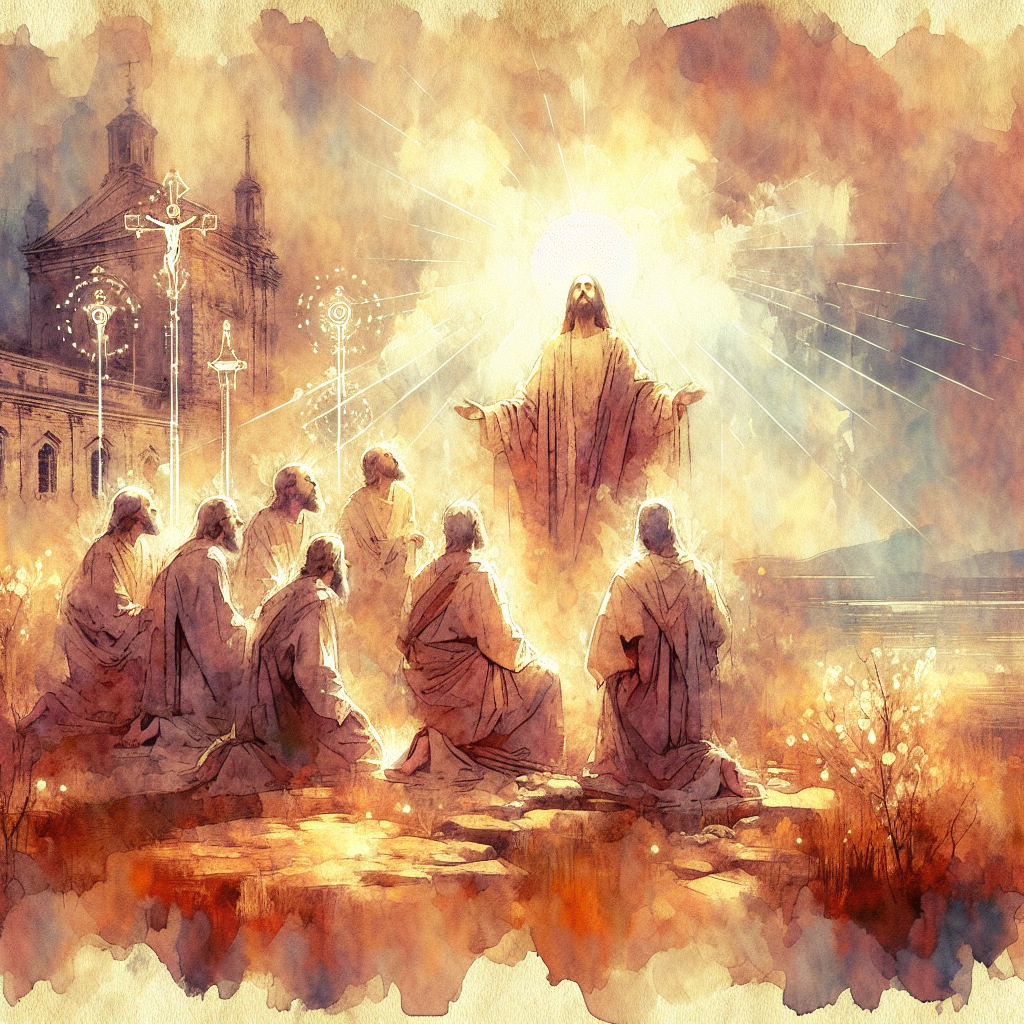
Water, Blood, and Spirit: The Three Witnesses
The churches around Ephesus are under siege.
Not from Rome—though that pressure never fully lifts. Not from synagogues—though that tension still simmers. From within. Teachers who walked with them, worshipped with them, then left. And the questions they raised haven't left with them.
Was Jesus really the Christ?
Did the divine truly become flesh?
Can you really know you have eternal life?
John writes to steady the shaken. The letter's final chapter is a cascade of assurances, a theological anchor thrown into the storm.
"Everyone who believes that Jesus is the Christ is born of God, and everyone who loves the father loves his child as well."
The confession matters. Not just knowing about Jesus—believing that Jesus is the Christ. ὁ Χριστός—the Anointed One, the Messiah, the fulfillment of Israel's hope. To believe this is evidence of birth from God. And those born of God love both the Father and the Father's other children.
The family resemblance runs in both directions.
"This is how we know that we love the children of God: by loving God and carrying out his commands. In fact, this is love for God: to keep his commands. And his commands are not burdensome."
The tests interlock. Love for God's children. Love for God. Obedience to commands. Each proves the others. Each flows into the others. And the commands—οὐ βαρεῖαί—are not heavy. Not crushing weights but liberating boundaries.
"For everyone born of God overcomes the world."
νικᾷ τὸν κόσμον—overcomes the world. Present tense. Continuous action. The battle isn't someday; it's now. And the born-of-God are winning.
"This is the victory that has overcome the world, even our faith."
Faith is the victory. Not willpower. Not moral achievement. Not spiritual heroics. πίστις—faith. Trust in the One who already won. The victory is past—νενίκηκεν, perfect tense—but we participate in it through present faith.
"Who is it that overcomes the world? Only the one who believes that Jesus is the Son of God."
The question and answer clarify everything. Who wins against the world-system, the organized rebellion, the values that invert heaven? Only one kind of person: the one who believes Jesus is God's Son. Not a good teacher. Not an enlightened master. The Son.
---
And now John summons witnesses.
"This is the one who came by water and blood—Jesus Christ. He did not come by water only, but by water and blood."
Water and blood. The phrase requires unpacking.
Water points to baptism—Jesus' baptism in the Jordan, where the Spirit descended, where the voice declared, "This is my beloved Son." The false teachers in John's day were willing to grant this. Yes, the Christ descended on Jesus at baptism. The divine came upon the human. They could affirm water.
But blood? Blood means the cross. Blood means the Messiah didn't just arrive—he died. He bled. He suffered. And the false teachers balked. The divine Christ, they claimed, departed before the crucifixion. The Christ didn't bleed. Only the human shell Jesus bled.
John insists: water and blood. Baptism and cross. Beginning and end. Both essential. Both confessed.
"And it is the Spirit who testifies, because the Spirit is the truth. For there are three that testify: the Spirit, the water and the blood; and the three are in agreement."
Three witnesses. In Jewish law, two or three witnesses established truth. John marshals three: the Spirit who testifies in the hearts of believers, the water of baptism, the blood of the cross. They agree. συμφωνοῦσιν—symphōnousin. They harmonize, they sound together, they sing the same song.
"We accept human testimony, but God's testimony is greater because it is the testimony of God, which he has given about his Son."
Human courts accept human witnesses. How much more should we accept divine testimony? And God has testified—about his Son, through Spirit and water and blood.
"Whoever believes in the Son of God accepts this testimony. Whoever does not believe God has made him out to be a liar, because they have not believed the testimony God has given about his Son."
The stakes are clear. Believe the testimony: you're aligned with God. Reject the testimony: you've called God a liar. There's no neutral ground.
"And this is the testimony: God has given us eternal life, and this life is in his Son."
The content of the testimony crystallizes. Eternal life. Not eventually—given. Not potentially—given. ζωὴν αἰώνιον, life of the age to come, already granted, already possessed.
"Whoever has the Son has life; whoever does not have the Son of God does not have life."
The binary returns. Have the Son: have life. Don't have the Son: don't have life. No third category. No partial possession.
---
John explains why he's written:
"I write these things to you who believe in the name of the Son of God so that you may know that you have eternal life."
So that you may know. εἰδῆτε—eidēte. Not guess. Not hope vaguely. Know. The false teachers specialize in uncertainty, in progressive doubt, in theological vertigo. John wants solid ground under his readers' feet.
You believe in the Son's name. You have eternal life. Know it.
"This is the confidence we have in approaching God: that if we ask anything according to his will, he hears us."
Confidence again. παρρησία—parrēsia. Boldness in prayer. Not cringing. Not uncertain. We approach knowing we're heard when we ask according to his will.
"And if we know that he hears us—whatever we ask—we know that we have what we asked of him."
The logic is simple. He hears us. Therefore we have what we asked. The asking according to his will ensures the granting—perhaps not in the form expected, but truly.
---
A difficult section follows:
"If you see any brother or sister commit a sin that does not lead to death, you should pray and God will give them life. I refer to those whose sin does not lead to death. There is a sin that leads to death. I am not saying that you should pray about that."
Sin that leads to death. ἁμαρτία πρὸς θάνατον. What is it? John doesn't specify. Interpreters have debated for centuries.
Perhaps the deliberate, persistent, final denial of Christ—the apostasy that severs all connection to the source of life. Perhaps the blasphemy against the Spirit that Jesus warned of. Perhaps something specific to John's context that we can't fully recover.
What's clear: some sins call for intercessory prayer that expects life. Others—the sin leading to death—are different. John doesn't forbid praying for such; he simply doesn't command it.
"We know that anyone born of God does not continue to sin; the One who was born of God keeps them safe, and the evil one cannot harm them."
Assurance deepens. The born-of-God don't continue in sin as a pattern. The One born of God—Jesus himself—keeps them. τηρεῖ αὐτόν—guards them, preserves them. And the evil one? οὐχ ἅπτεται αὐτοῦ—does not touch them. Cannot lay hold of them. The grip of God is stronger than the grasp of Satan.
"We know that we are children of God, and that the whole world is under the control of the evil one."
The contrast is stark. Two spheres. Children of God. The world under the evil one's control. κεῖται—lies under, is positioned under, rests under. The whole κόσμος. But we—we are ἐκ τοῦ θεοῦ—from God, belonging to God, positioned differently.
"We know also that the Son of God has come and has given us understanding, so that we may know him who is true."
Three "we knows" in rapid succession. We know we don't continue in sin. We know we're children of God. We know the Son has come and given understanding. The repetition hammers the assurance home.
"And we are in him who is true by being in his Son Jesus Christ. He is the true God and eternal life."
The climax. We are in him who is true. In the true God. By being in Jesus Christ. And that Jesus Christ—he is the true God and eternal life. The full deity of Christ, stated plainly. ὁ ἀληθινὸς θεός—the true God.
"Dear children, keep yourselves from idols."
The letter ends abruptly. φυλάξατε ἑαυτὰ ἀπὸ τῶν εἰδώλων. Guard yourselves from idols. From false gods. From the substitutes that pretend to offer what only the true God provides.
---
The churches around Ephesus receive this letter.
They've weathered the schism. They've endured the questions. They've heard the false teaching about Christ not really coming in flesh, not really dying, not really bleeding.
John writes: Water and blood. He came through both. The Spirit testifies. The witnesses agree.
And you—you who believe—you have eternal life.
Know it.
Rest in it.
Keep yourselves from idols.
The true God is enough.
Creative Approach
historical_reconstruction
Powered by ChurchWiseAI
This illustration is a preview of what our AI-powered ministry platform can do. ChurchWiseAI offers a full suite of tools built for pastors and church leaders.
Sermon Companion
Build entire sermons with AI — outlines, illustrations, application points, and slide decks tailored to your tradition.
Ministry Chatbot
An AI assistant trained on theology, counseling frameworks, and church administration to help with any ministry question.
Bible Study Builder
Generate discussion guides, devotionals, and small group materials from any passage — in minutes, not hours.
Try any app free for 7 days — no credit card required.
Get Started