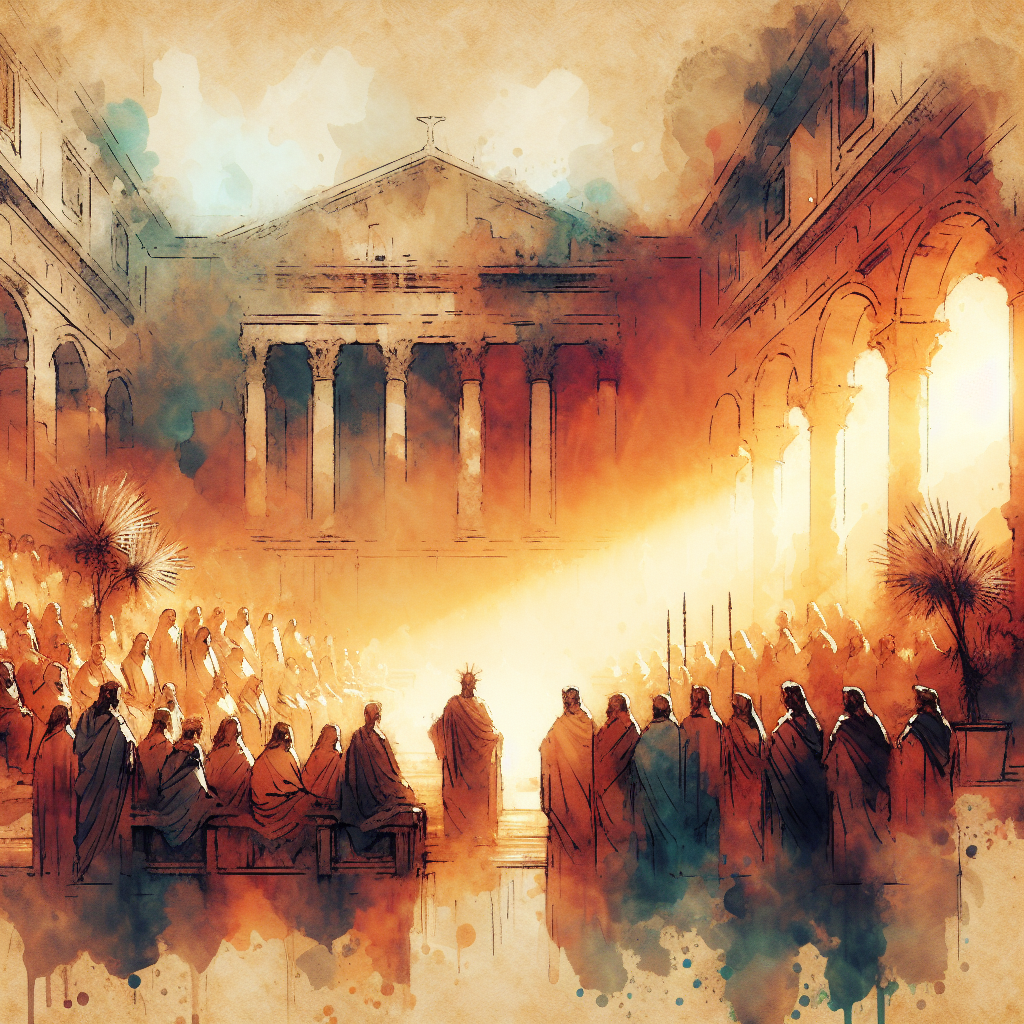
What Is Truth?: John 18:28-19:16
Then the Jewish leaders took Jesus from Caiaphas to the palace of the Roman governor. By now it was early morning, and to avoid ceremonial uncleanness they did not enter the palace, because they wanted to be able to eat the Passover.
The irony was thick. They would not enter a Gentile building—ceremonial defilement. But they would condemn an innocent man. Scrupulous about ritual, casual about justice.
So Pilate came out to them and asked, What charges are you bringing against this man?
Pilate accommodated their scruples, meeting them outside.
If he were not a criminal, they replied, we would not have handed him over to you.
No specific charge—just trust us. He's guilty.
Pilate said, Take him yourselves and judge him by your own law.
But we have no right to execute anyone, the Jewish leaders objected.
The truth emerged. They wanted death. Roman authority was required for execution.
Pilate then went back inside the palace, summoned Jesus and asked him, Are you the king of the Jews?
King of the Jews? Pilate got to the political charge—the one that would matter to Rome.
Is that your own idea, Jesus asked, or did others talk to you about me?
Jesus answered question with question. Whose idea is this, Pilate?
Am I a Jew? Pilate replied. Your own people and chief priests handed you over to me. What is it you have done?
Pilate's contempt showed. Am I a Jew? Your own people condemn you.
Jesus said, My kingdom is not of this world. If it were, my servants would fight to prevent my arrest by the Jewish leaders. But now my kingdom is from another place.
Not of this world. No armies, no rebellion, no political revolution. A different kind of kingdom entirely.
You are a king, then! said Pilate.
Jesus answered, You say that I am a king. In fact, the reason I was born and came into the world is to testify to the truth. Everyone on the side of truth listens to me.
Born for truth. The purpose of the incarnation distilled: to testify to truth. Truth has a side, and Jesus is on it.
What is truth? retorted Pilate. With this he went out again to the Jews gathered there and said, I find no basis for a charge against him.
What is truth? The question of philosophy, asked of Truth himself, then dismissed without waiting for an answer. Pilate walked away from the answer standing before him.
But it is your custom for me to release to you one prisoner at the time of the Passover. Do you want me to release the king of the Jews?
A way out. Passover amnesty. Surely they would choose Jesus.
They shouted back, No, not him! Give us Barabbas! Now Barabbas had taken part in an uprising.
Barabbas—insurrectionist, murderer. The crowd chose violence over the Prince of Peace.
Then Pilate took Jesus and had him flogged.
Roman flogging—leather strips with bone and metal, tearing flesh. Punishment before verdict.
The soldiers twisted together a crown of thorns and put it on his head. They clothed him in a purple robe and went up to him again and again, saying, Hail, king of the Jews! And they struck him in the face.
Mock coronation. Thorns for crown, purple for royalty, blows for homage. The soldiers made sport of the accused king.
Once more Pilate came out and said to the Jews gathered there, Look, I am bringing him out to you to let you know that I find no basis for a charge against him.
No basis—yet the flogging proceeded. Justice crumbled before expediency.
When Jesus came out wearing the crown of thorns and the purple robe, Pilate said to them, Here is the man!
Ecce homo. Behold the man. Pilate presented the bruised, bleeding, mocked figure—perhaps hoping for pity.
As soon as the chief priests and their officials saw him, they shouted, Crucify! Crucify!
No pity. Only the cry for death.
Pilate answered, You take him and crucify him. As for me, I find no basis for a charge against him.
Three times Pilate declared innocence. Three times he moved toward execution anyway.
The Jewish leaders insisted, We have a law, and according to that law he must die, because he claimed to be the Son of God.
Son of God. Pilate's concern deepened.
When Pilate heard this, he was even more afraid, and he went back inside the palace. Where do you come from? he asked Jesus, but Jesus gave him no answer.
Fear—where does this man come from? Silence from Jesus.
Do you refuse to speak to me? Pilate said. Don't you realize I have power either to free you or to crucify you?
Pilate asserted power. But did he have it?
Jesus answered, You would have no power over me if it were not given to you from above. Therefore the one who handed me over to you is guilty of a greater sin.
Power from above—delegated, not ultimate. Pilate was a tool in a larger drama.
From then on, Pilate tried to set Jesus free, but the Jewish leaders kept shouting, If you let this man go, you are no friend of Caesar. Anyone who claims to be a king opposes Caesar.
The political threat. Friend of Caesar was a technical term, a status Pilate could not afford to lose.
When Pilate heard this, he brought Jesus out and sat down on the judge's seat at a place known as the Stone Pavement.
It was the day of Preparation of the Passover; it was about noon.
Preparation Day. The lambs were being slaughtered in the temple. The true Lamb stood before judgment.
Here is your king, Pilate said to the Jews.
But they shouted, Take him away! Take him away! Crucify him!
Shall I crucify your king? Pilate asked.
We have no king but Caesar, the chief priests answered.
The theocracy ended with those words. We have no king but Caesar. Israel rejected her Messiah definitively.
Finally Pilate handed him over to them to be crucified.
Finally. The drama ended where it was always heading. Truth stood before power. Power could not recognize truth. And truth went to the cross.
Powered by ChurchWiseAI
This illustration is a preview of what our AI-powered ministry platform can do. ChurchWiseAI offers a full suite of tools built for pastors and church leaders.
Sermon Companion
Build entire sermons with AI — outlines, illustrations, application points, and slide decks tailored to your tradition.
Ministry Chatbot
An AI assistant trained on theology, counseling frameworks, and church administration to help with any ministry question.
Bible Study Builder
Generate discussion guides, devotionals, and small group materials from any passage — in minutes, not hours.
Try any app free for 7 days — no credit card required.
Get Started