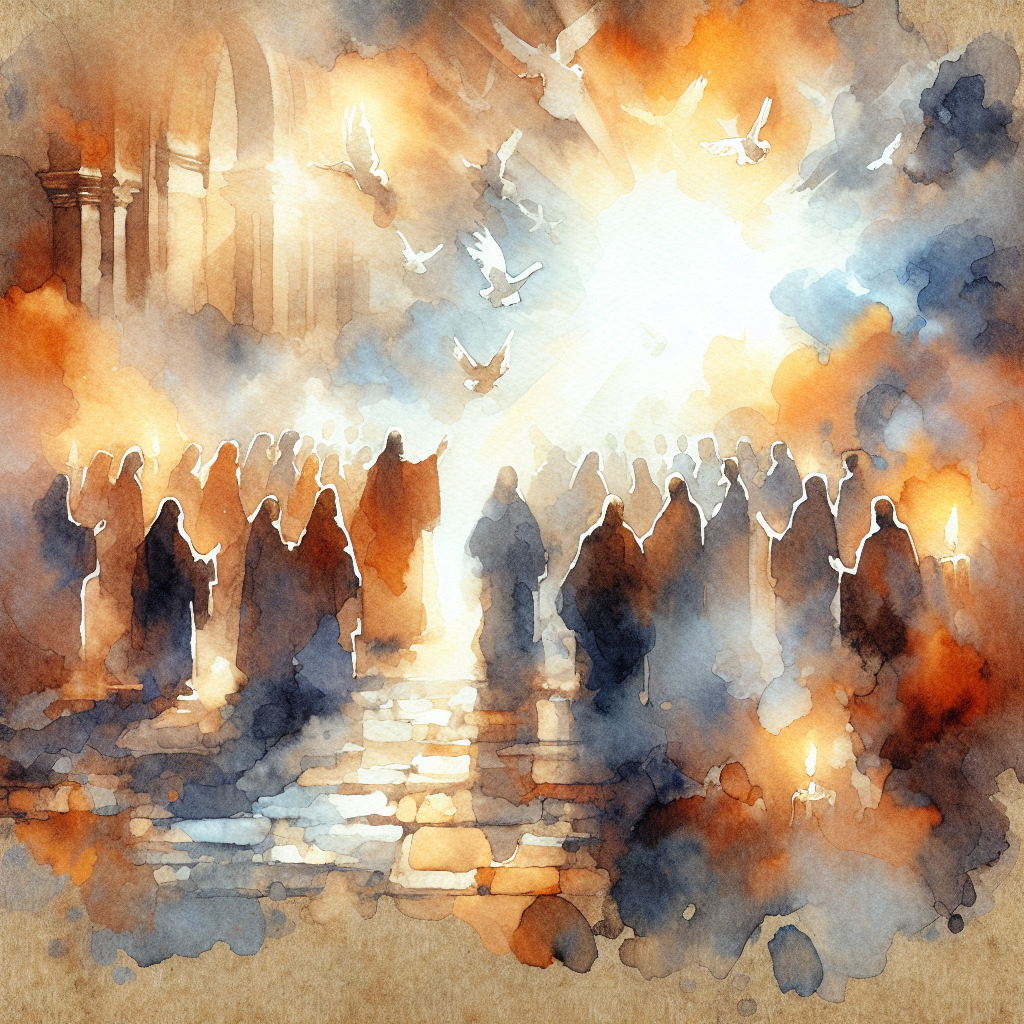
Wind and Fire: Acts 2:1-21
When the day of Pentecost came, they were all together in one place.
Pentecost—the Feast of Weeks, fifty days after Passover. Jerusalem packed with pilgrims from across the known world. The disciples gathered, waiting as commanded. One place. One purpose. One expectation.
Suddenly a sound like the blowing of a violent wind came from heaven and filled the whole house where they were sitting.
Suddenly. No warning. A sound—not wind itself but like wind. Violent wind—the Greek word suggests a rushing, mighty breath. From heaven—origin unmistakable. Filling the house—every corner, every person surrounded by the roar.
The Hebrew word for Spirit is ruach—breath, wind. The Spirit came as wind.
They saw what seemed to be tongues of fire that separated and came to rest on each of them.
Fire appeared. Tongues of fire—flame-shaped, language-shaped. Separating, individualizing, resting on each one. Not one great bonfire but personal flames. Each disciple marked. Each one receiving.
The God who spoke from the burning bush, who descended on Sinai in fire, who led Israel as a pillar of fire—that God now rested as fire on each believer.
All of them were filled with the Holy Spirit and began to speak in other tongues as the Spirit enabled them.
Filled. The promise fulfilled. The Holy Spirit—not near them but in them. And immediately: speech. Other tongues—languages they had never learned, words they had never studied. The Spirit enabled what education never could.
Now there were staying in Jerusalem God-fearing Jews from every nation under heaven.
The audience had gathered. Diaspora Jews—scattered across the Roman world and beyond—now in Jerusalem for the feast. Every nation under heaven represented. The stage was set for a global announcement.
When they heard this sound, a crowd came together in bewilderment, because each one heard their own language being spoken.
The sound drew them. The crowd assembled. And then bewilderment—each person heard their own language. Galilean fishermen speaking Persian, Egyptian, Mesopotamian, Cappadocian. Native languages from native speakers who had never been to those places.
Utterly amazed, they asked: Aren't all these who are speaking Galileans? Then how is it that each of us hears them in our native language?
The question of astonishment. Galileans—the accent was unmistakable, the provincial origin obvious. How then the perfect Persian? The fluent Phrygian? The native Parthian?
Parthians, Medes and Elamites; residents of Mesopotamia, Judea and Cappadocia, Pontus and Asia, Phrygia and Pamphylia, Egypt and the parts of Libya near Cyrene; visitors from Rome (both Jews and converts to Judaism); Cretans and Arabs—we hear them declaring the wonders of God in our own tongues!
The roll call of nations. From Parthia in the east to Rome in the west. From Pontus in the north to Egypt in the south. Arabs and Cretans. Jews by birth and converts by choice. All hearing the wonders of God in languages they learned at their mothers' knees.
Babel reversed. At Babel, God confused languages to scatter humanity. At Pentecost, God multiplied languages to gather humanity. The curse became a blessing.
Amazed and perplexed, they asked one another, What does this mean?
The right question. What does this mean? Something unprecedented was happening. The explanation was needed.
Some, however, made fun of them and said, They have had too much wine.
The skeptics appeared. Drunk at nine in the morning. The miraculous reduced to the mundane. The supernatural explained away.
Then Peter stood up with the Eleven, raised his voice and addressed the crowd.
Peter stood. The denier became the declarer. The one who had cowered before a servant girl now addressed thousands. The Spirit made the difference.
Fellow Jews and all of you who live in Jerusalem, let me explain this to you; listen carefully to what I say. These people are not drunk, as you suppose. It's only nine in the morning!
The defense began with humor. Too early for drunkenness. Something else was happening.
No, this is what was spoken by the prophet Joel: In the last days, God says, I will pour out my Spirit on all people.
Joel's prophecy—quoted, claimed, fulfilled. The last days had begun. The Spirit poured out. Not on prophets only, not on kings only, not on priests only—on all people.
Your sons and daughters will prophesy, your young men will see visions, your old men will dream dreams. Even on my servants, both men and women, I will pour out my Spirit in those days, and they will prophesy.
The democratization of the Spirit. Sons and daughters. Young and old. Men and women. Servants included. All prophesying. The Spirit was no longer the privilege of the few but the promise to the many.
I will show wonders in the heavens above and signs on the earth below, blood and fire and billows of smoke. The sun will be turned to darkness and the moon to blood before the coming of the great and glorious day of the Lord.
Cosmic signs announced. The day of the Lord approaching. The final drama beginning.
And everyone who calls on the name of the Lord will be saved.
The invitation embedded in the prophecy. Everyone—no restrictions. Calls on the name—the response of faith. Will be saved—the certain result.
The Spirit had come. The church was born. The mission to the ends of the earth had begun—in a room, with fire, in every language under heaven.
Powered by ChurchWiseAI
This illustration is a preview of what our AI-powered ministry platform can do. ChurchWiseAI offers a full suite of tools built for pastors and church leaders.
Sermon Companion
Build entire sermons with AI — outlines, illustrations, application points, and slide decks tailored to your tradition.
Ministry Chatbot
An AI assistant trained on theology, counseling frameworks, and church administration to help with any ministry question.
Bible Study Builder
Generate discussion guides, devotionals, and small group materials from any passage — in minutes, not hours.
Try any app free for 7 days — no credit card required.
Get Started